AI & Technology Patent Strategy The Analogy Engine ⏱ 9 min read

Hallucinations in AI patent drafting
are not a software bug.
They are a radar signature.

Four generations of fighter jets built faster, smarter, more capable aircraft that were still visible to radar. Four generations of patent AI built faster, smarter, more capable drafters that still hallucinate. The problem was never performance. It was design philosophy.

TA

Tabrez Alam

July 2, 2026 · Founder, eety.ai

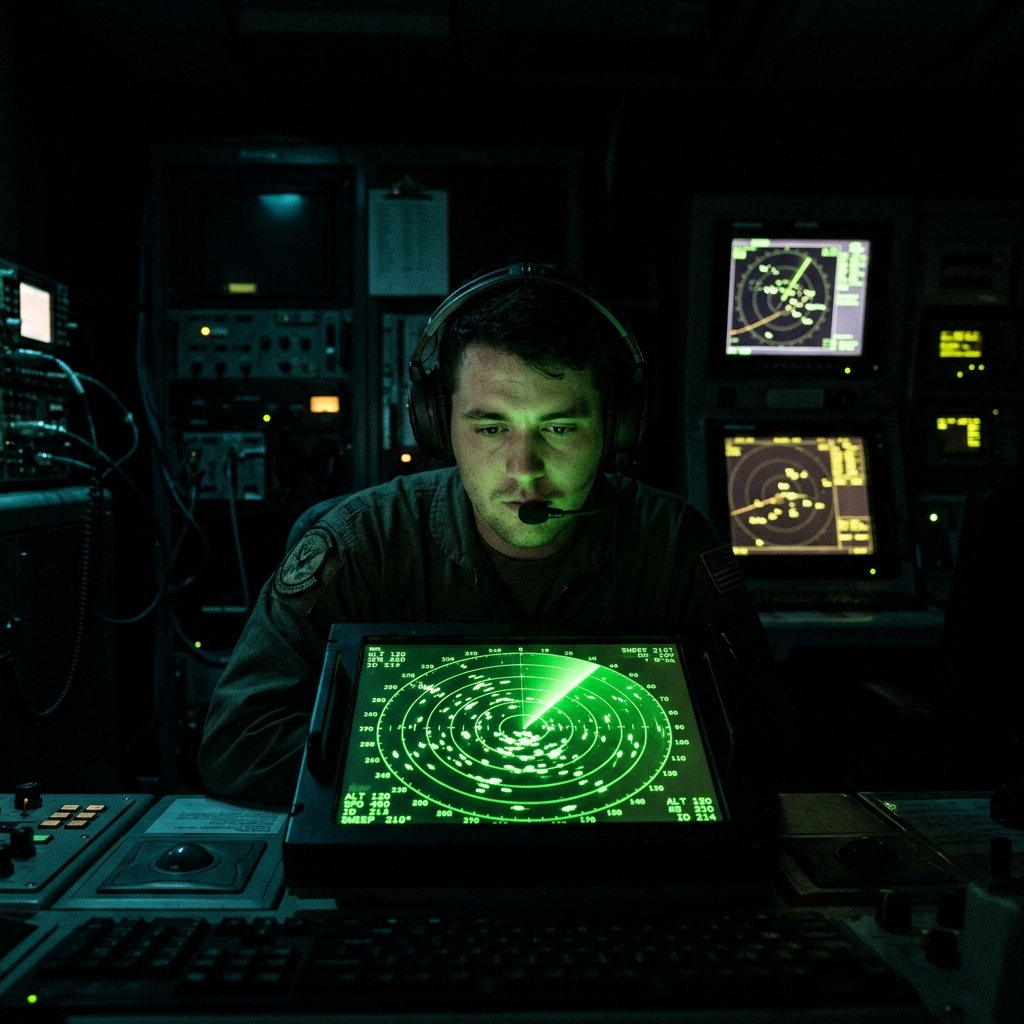
A radar operator in a darkened control room, face lit by the green glow of a circular radar sweep screen, tracking blips visible on surrounding displays
Act I: The problem nobody calls by its right name

Here is the thing about an AI hallucination in a patent application that makes it different from any other kind of software error.

It does not know it has happened.

A syntax error crashes the program. A calculation error returns a wrong number. Both announce themselves. You find them because they are wrong in an obvious way.

An AI hallucination in a patent draft is fluent, confident, and grammatically impeccable. The sentence that describes a sensor array your client never built reads exactly like the sentence that describes the microprocessor your client actually did build. The paragraph that introduces a prosecution-limiting restriction reads exactly like the paragraph that accurately describes the claimed embodiment. There is no flag. There is no warning. The model generated both with identical certainty, because the model has no way to distinguish between what it knows and what it is constructing from the shape of the surrounding text.

This is not a quality problem. It is a structural one. And five generations of fighter jet aviation explain exactly what I mean.

The sentence that describes a sensor array your client never built reads exactly like the sentence that describes the component they actually did.
Act II: Gen 1 through Gen 4

From 1944 to the mid-1970s, the question that drove fighter design was a simple one. How do we make it perform better?

Each generation had a different answer.

The first generation said: jets. Replace the piston engine with a turbine. The Me 262, the Gloster Meteor, the F-80 Shooting Star. Remarkable aircraft. Still subsonic. Still guns only. The tactics were World War II tactics at higher speed; the jet engine was a single upgrade dropped into an otherwise unchanged design philosophy.

The second generation said: supersonic. Break the sound barrier. Add radar. Replace guns with guided missiles, because missiles are smarter than bullets and the close-turning dogfight is obsolete. This was partially right. Vietnam proved it partially wrong. The F-4 Phantom had been designed without a gun because missiles were going to replace them. In actual combat, the missiles failed constantly. The gun was retrofitted. The pilots who had trained for standoff missile engagements had to relearn the close dogfight they had been told they would never fight again.

The third generation said: Mach 2. And multi-role. The F-4, the MiG-21, the Mirage III. Aircraft that could engage targets they could not see, carry air-to-air and air-to-ground weapons on the same airframe, and fly at speeds that made earlier aircraft look stationary.

The fourth generation said: everything. Fly-by-wire, so the computer manages the flight envelope and the pilot commands outcomes rather than inputs. Look-down/shoot-down radar, so low-altitude targets could no longer hide in ground clutter. Aerial refuelling as standard, so range became effectively unlimited. HOTAS, so the pilot never took their hands off the controls. Advanced electronic warfare. BVR missiles that genuinely worked... The F-15 Eagle. The F-16 Fighting Falcon. The Su-27 Flanker. By the time the F-15 entered service in 1976, everything that could be improved about the fighting aircraft had been improved.

Four Generations · One Unchanged Flaw
Gen Defining Capability What it did not solve
Gen 1 Jet propulsion. Faster than propellers. Subsonic. No sensors. Guns only.
Gen 2 Supersonic. Radar. First guided missiles. Doctrine outran the technology. Guns abandoned, then needed.
Gen 3 Mach 2+. BVR missiles. Multi-role. Speed at cost of low-speed handling. Radar visibility untouched.
Gen 4 Fly-by-wire. HOTAS. Unlimited range. EW. BVR that worked. Completely visible to radar. The perfect aircraft that could still be tracked from 200 km.

The F-15 Eagle has an aerial combat record that no other aircraft in history matches: over 100 confirmed kills, zero losses in air-to-air combat. It is, by every measurable performance criterion, a perfect aircraft.

It is also completely, totally, unambiguously visible to radar.
Act III: The ceiling

The F-15's radar cross-section is roughly equivalent to a large truck. The S-400 sees it from 200 kilometres away.

The conseuqence of being visible is that on a bad day, with a good enough air defense system, the pilot gets detected and engaged before they can do anything useful. The entire performance advantage of the Gen 4 aircraft is available only after the aircraft has survived detection. And surviving detection requires the pilot to do a great deal of work that has nothing to do with the mission.

Go faster. Fly lower. Jink to break a missile lock. Deploy chaff and flares. Request electronic warfare support. Plan routes around known SAM battery locations. Send SEAD packages ahead to suppress the air defenses before the main force can proceed... All of this is downstream management of a problem that was never addressed at source.

It worked. The F-15 dominated every engagement it entered, precisely because skilled pilots and excellent tactics managed the consquences of visibility so effectively that the underlying flaw rarely became fatal.

But "rarely fatal" is not "solved." And the engineers who designed the F-22 understood the distinction.

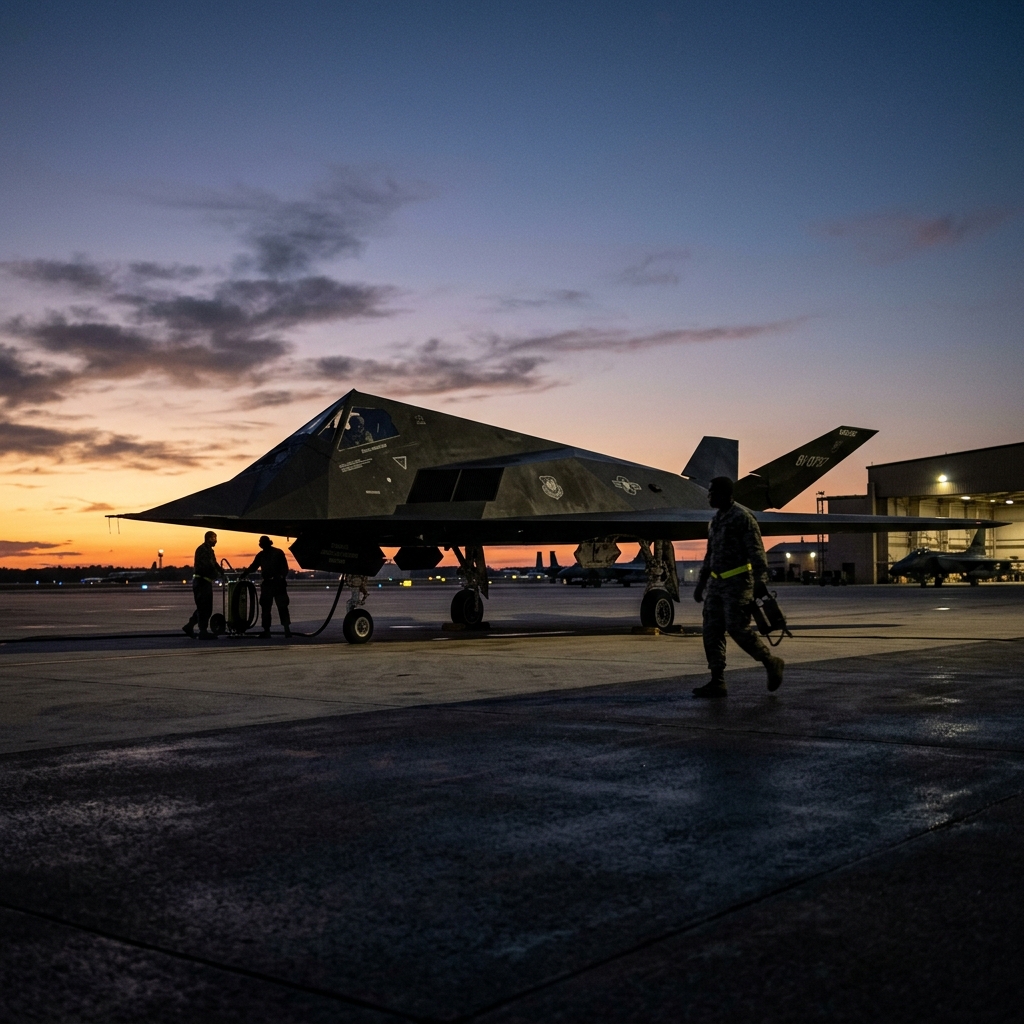
A stealth aircraft on a flight line at dusk, its angular geometric surfaces catching the last light, ground crew in silhouette

This is not a fast aircraft pretending to be invisible.
The geometry is the answer. Every angle was a design decision.

A conversation I keep having · verbatim
Him
"The newer models are much better. I get maybe one or two hallucinated elements per application now. Six months ago it was five or six."
Me
"That is like saying the F-16 was a better fighter than the F-4 because fewer missiles hit it."
Him
"What?"
Me
"The improvement is completely real. The F-16 was genuinely better in every measurable way. It was still visible to radar. The metric you are tracking; hallucinations per application; is the pilot's dodge rate. Useful to know. Still the wrong problem to be optimising around."
Act IV: The question nobody asked for 40 years

The F-22 Raptor did not ask how to survive radar detection more effectively. It asked what would happen if the radar had nothing to detect.

All-aspect stealth. The geometry of every surface designed so that radar energy bounces away from the receiver rather than back to it. The F-22's estimated radar cross-section is approximately 0.0001 square metres. The S-400 system that detects an F-15 from 200 kilometres cannot reliably detect an F-22 from five. By the time any radar gets a usable return, the mission is complete and the aircraft is gone...

The stealth is not a coating. It is not a capability bolted on after the airframe was designed. It is the design. The angles of the fuselage, the internal weapons bays (external pylons create their own radar returns), the shaped engine intakes that hide the turbine face, the blended wing-body junction where a conventional aircraft's junction would scatter radar energy directly back to the receiver. All of it is the stealth. You cannot retrofit this onto an F-15 any more than you can retrofit a marble's radar cross-section onto a truck.

Actually, let me be more precise here. Because the stealth is not the point of the Gen 5 aircraft. It is the precondition for everything else. The F-22 pilot flies missions that Gen 4 pilots could not fly; not because the F-22 is faster, but because the missions that were impossible with a visible aircraft are now possible with an invisible one. The stealth removed a constraint; the pilot uses the freedom the removed constraint created.

The pilot on the F-22 still flies. Still makes tactical decisions. Still has to employ weapons correctly and manage fuel and navigate. But one entire category of threat; the most lethal one; has been removed from the in-flight workload by decisions made in the hangar, years before the mission, by engineers who asked a different question.

Act V: The same question, applied to patent AI

Every generation of patent AI before eety built a better drafter that still hallucinated.

The first generation was template libraries and clause databases. Faster than typing from scratch. Visible: the gaps were immediately obvious because the templates had gaps that no AI was filling.

The second generation was general-purpose LLMs prompted for patent output. Dramatically faster. Dramatically more hallucination-prone, and the hallucinations were fluent enough to require expert reading to catch. The attorney started spending time they had not expected to spend.

The third generation was dedicated patent AI: models fine-tuned on patent corpora, better domain understanding, more consistent claim structure. Fewer hallucinations per page. Still hallucinating. The improvement was real. The problem was the same.

The fourth generation is where the market sits today. Full workflow integration. Document upload and RAG retrieval. Style adaptation. Claim editing. Review checklists. Electronic warfare equivalents: tools designed to help you find the hallucinations more efficiently. The attorney's dodge rate has improved. The attorney is still dodging.

The hallucination in a patent AI system has a source. The source is a gap: a piece of information the model needed to draft accurately that was not present in the input, and that the model is not designed to flag as missing. The model fills the gap with the most plausible continuation of the surrounding text. The result is a sentence that reads like a correct sentence but describes something that does not exist. The model has no way to know this. It was not asked to know this.

Every generation of patent AI built a faster, smarter drafter that was still visible. The hallucination was always there. The attorneys learned to manage it the way Gen 4 pilots learned to manage radar.

I mentioned this framing to a young woman who runs a boutique IP practice in Bengaluru. She had been using one of the generation-three tools for about a year and had started keeping, I am not inventing this, a separate Word document she called "AI inventions": a running log of things the tool had hallucinated that sounded so convincingly real she had almost let them through. She showed me three entries at random. Each one was a technical feature described with complete specificity, the right terminology, the right relationship to the surrounding claims. None of it existed in any disclosure she had received. The AI had, quite casually, been innovating on her clients' behalf.

She told me she spent somewhere around Rs 800 per application maintaining that log... cross-referencing it against new drafts to catch recurring hallucination patterns. That number sounds small until you realise it is her time, not a subscription fee. And it is time spent entirely on a problem that should not exist. :(

eety.ai's answer to this is not a better gap-filler. It is a 15-point pre-flight diagnostic run before a single word of the draft is generated. Is the technical problem clearly stated? Is the proposed solution causally connected to that problem? Are the components described with sufficient specificity to support the claims? Does the described embodiment function the way the inventor says it does? If the answer to any of these is absent or unclear, the system does not draft. It asks. The draft does not exist until the gaps do not exist.

Which means there is no gap for the model to fill with a plausible guess. Which means there is no hallucination... not managed, not reduced, not detected post-hoc. Structurally impossible. The geometry of the pre-flight diagnostic is the stealth airframe. The precondition for the hallucination was eliminated before the mission began.

The F-15 is not a flawed aircraft. I want to say this clearly before I close, because it would be easy to walk away with the wrong impression. The F-15 is one of the finest machines human beings have ever built. The point is not that Gen 4 failed. The point is that Gen 4 perfected a design philosophy that had an assumption baked into it from the start: that visibility is a given, and the pilot must manage its consequences.

Gen 5 challenged the assumption. Not the aircraft.

The patent AI tools that preceded eety are not bad products. Some of them are excellent. The point is that they are excellent at being drafters who hallucinate less, not at being systems that do not hallucinate. The assumption baked in from the start was: gaps exist, the model fills them, the attorney finds and corrects the fills. The entire apparatus of review workflows, RAG retrieval, and hallucination-rate benchmarking is built around that assumption.

eety.ai challenged the assumption. The attorney who uses it does not spend the session finding what the model invented. They spend it answering structured questions about what their client actually built. By the time the draft arrives, there is nothing to hunt for. :)

"The pilot who is not visible does not spend the mission evading missiles. The attorney whose draft contains no hallucinations does not spend the review finding them."

I went back and read through that Word document she showed me. Forty-three entries over eleven months. I keep thinking about entry eleven. It described a heat dissipation mechanism in such precise, technically coherent detail that I had to read the original disclosure three times before I was certain it had never been mentioned. I am not sure this observation is finished. I am sure it is honest. That will have to do for now.

See what the pre-flight diagnostic finds

Upload a real disclosure.
See what eety.ai asks before it drafts.

The questions are not obstacles. They are the inventory of what the model would otherwise have guessed. Most attorneys say reading the questions is more useful than reading the draft.

Continue Reading