Patent Drafting

A complete application, drafted like your firm wrote it.

Claims, drawings, and the full specification for 5 tokens ($50), charged once per matter. Eety will not write a word until it understands the invention at 90 percent confidence, and it asks your inventor about what it does not know instead of inventing it.

Start Free

Templates for 5 patent offices: USPTO, EPO, PCT/WIPO, UKIPO, IPO India. 25 free tokens at signup ($250 of work). No credit card.
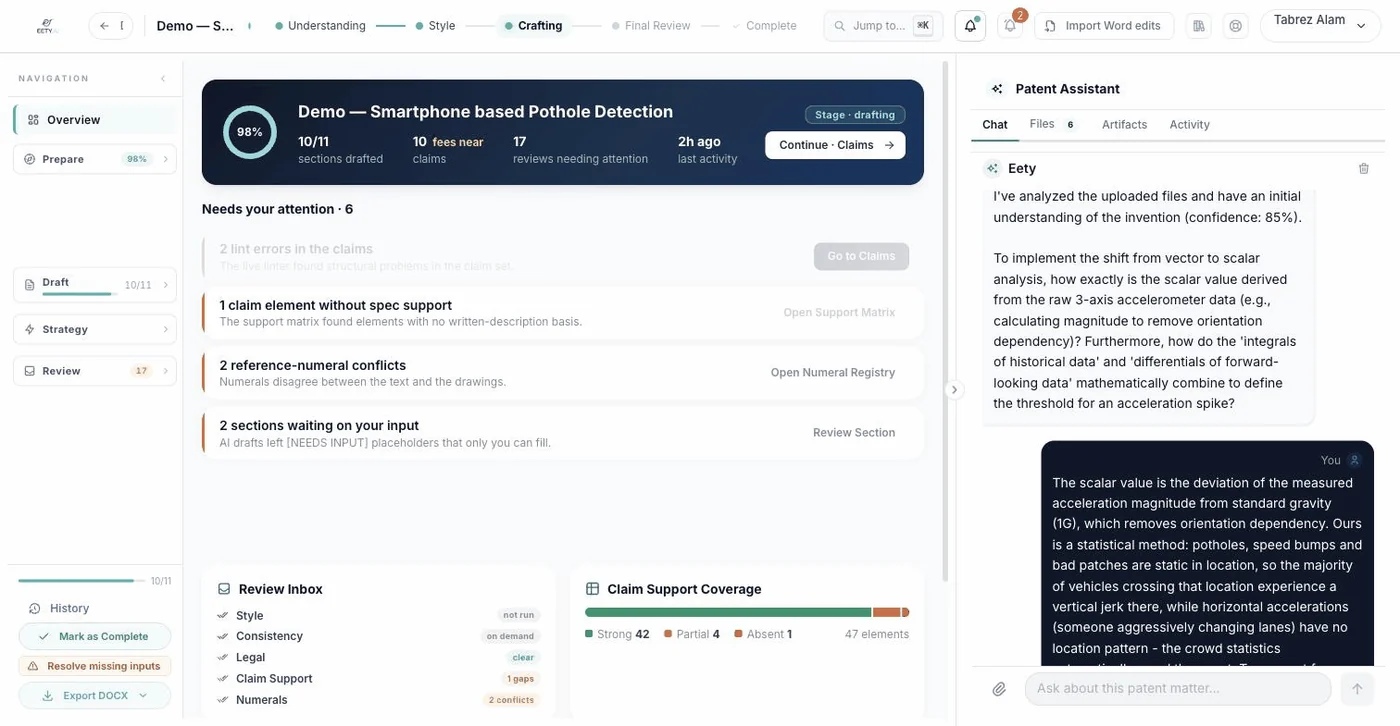
The matter after a full draft: sections drafted, claim support measured, and the live QA findings waiting.
The matter after a full draft: sections drafted, claim support measured, and the live QA findings waiting.
Before and After

The week an application takes, and the afternoon it could.

The Old Way
  1. Day 1

    Read the disclosure. Start a questions list for the inventor. Wait for replies.

  2. Day 2

    Draft the claims by hand. Renumber them. Renumber them again.

  3. Day 3

    Write the detailed description, keeping every reference numeral aligned by eye.

  4. Day 4

    Brief the drawings to a draftsman. Wait for the files to come back. Reconcile them with the spec.

  5. Day 5

    Proofread for antecedent basis, claim support, and numbering. Hope nothing slipped.

With eety
  1. Minute 0

    Upload the disclosure, the prior art, and one reference patent your firm has filed.

  2. The Interview

    Eety asks the inventor targeted questions until its understanding reaches 90 percent confidence. It refuses to draft before that.

  3. The Draft

    Claims first, then every section in parallel. Patent drawings are generated from the specification, and the detailed description follows the figures.

  4. The Margin

    QA runs live as you edit: antecedents, numbering, claim support. Anything eety does not know stays flagged as an inventor input.

  5. Export

    A filing-ready DOCX for the patent office you picked. 5 tokens, charged once for the matter, redraft as often as you need.

How It Works

Six steps from disclosure to filing-ready DOCX.

1

Upload the matter

It is how you would brief a new associate: hand over the file, plus one of your issued patents, and say "write it like this one." Upload the invention disclosure, the prior art you have, and a style reference patent your firm drafted. That is the whole setup.

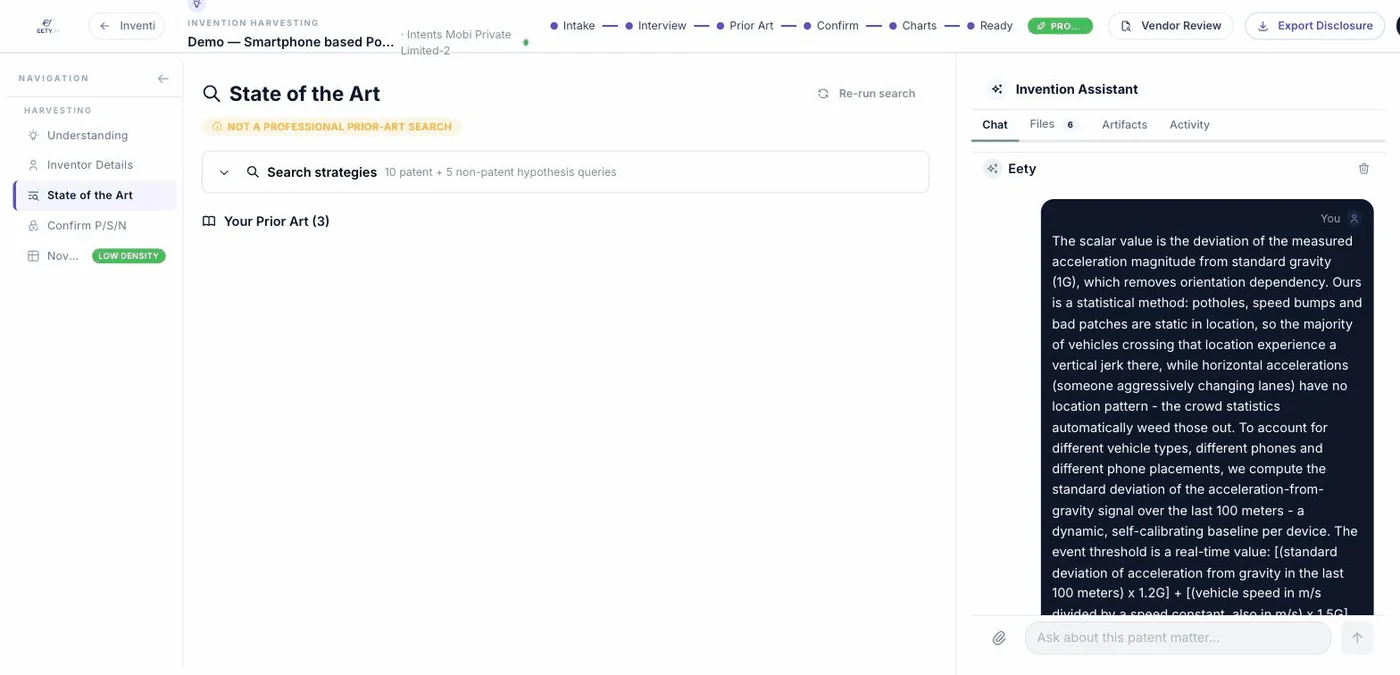
Prior art sitting in the matter, each document summarised as it was ingested.

Prior art sitting in the matter, each document summarised as it was ingested.

2

The 90 percent gate

A careful associate does not start typing the moment the disclosure lands. They read it, then come back with a list of questions. Eety does the same: it builds an invention understanding from your documents and will not draft until that understanding reaches 90 percent confidence. Below the gate, it interviews the inventor about the gaps.

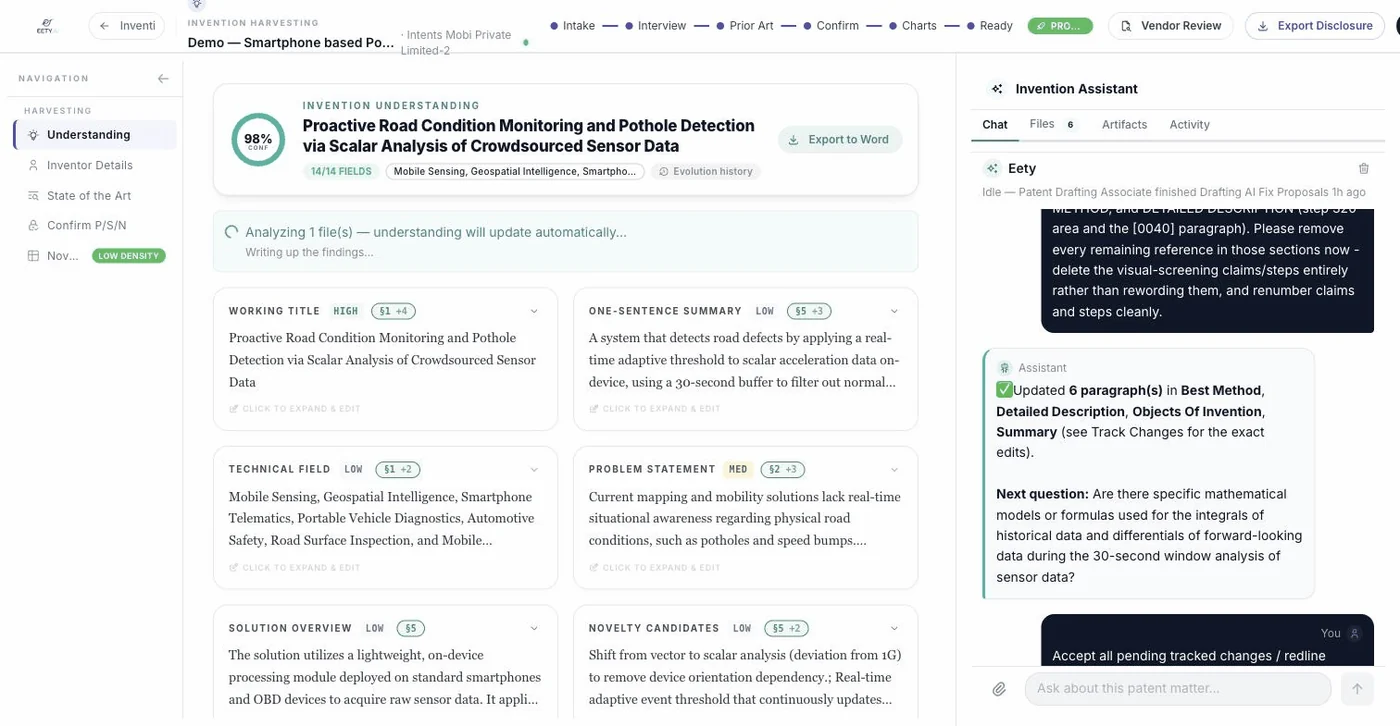
The understanding panel with the open inventor questions that stand between it and drafting.

The understanding panel with the open inventor questions that stand between it and drafting.

3

Your style, distilled

Every firm has a house voice, the way a senior partner can name the author of a specification from one page. Eety distills a style profile from your reference patent: its structure, its phrasing, its claim style. The draft is written to that profile, not to a generic template voice.

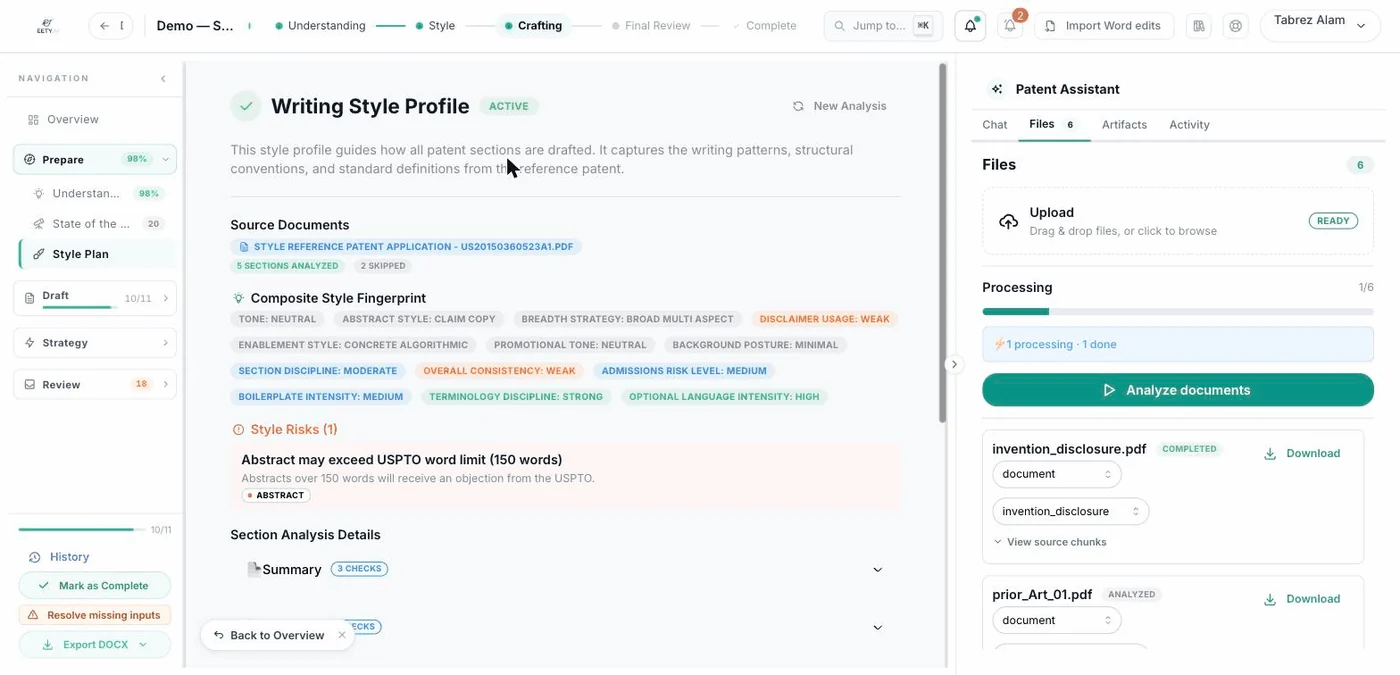
The style profile distilled from a reference patent: tone, enablement style, terminology discipline, and the risks it flags.

The style profile distilled from a reference patent: tone, enablement style, terminology discipline, and the risks it flags.

4

All sections in parallel

Once a drafting team agrees on the claims, the sections can be split across the room instead of written one after another. Eety drafts the claims first, generates the patent drawings from the specification, and writes the detailed description to follow the figures, with all sections drafted in parallel rather than in sequence.

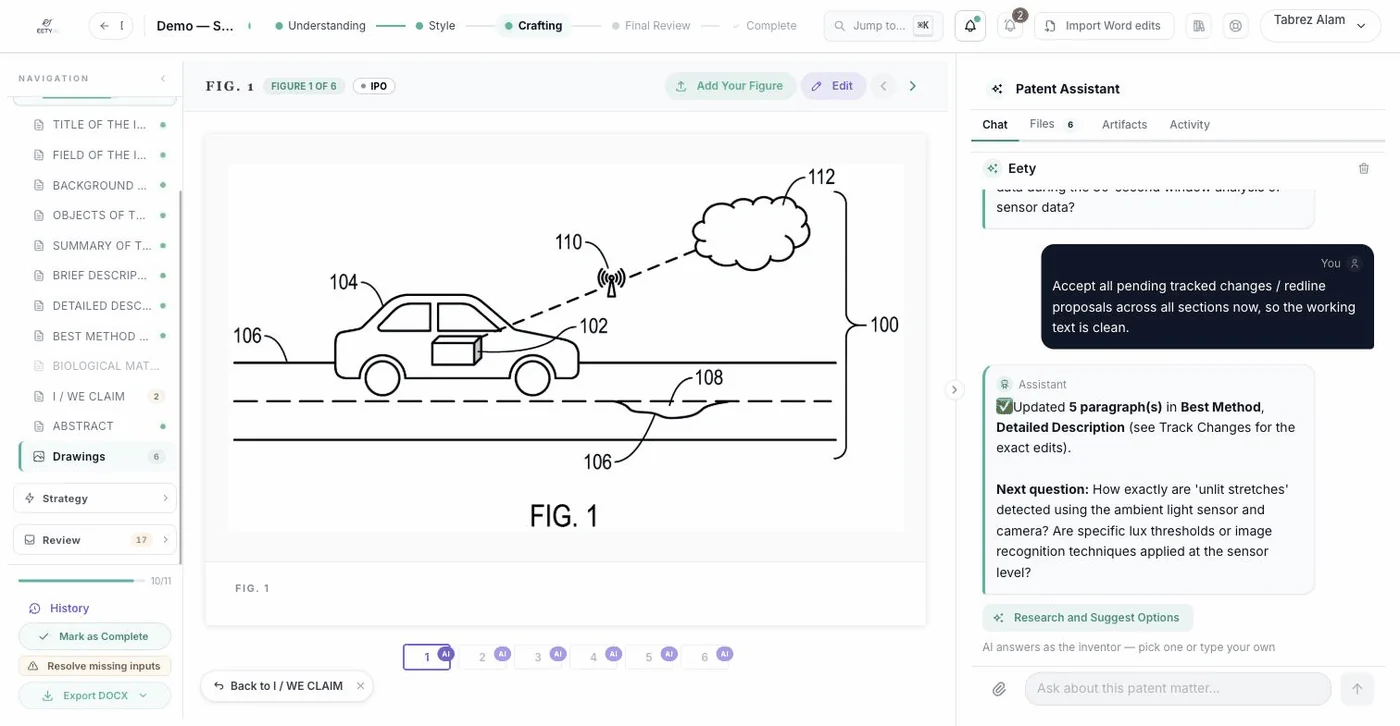
A generated figure: FIG. 1 with reference numerals that match the description text.

A generated figure: FIG. 1 with reference numerals that match the description text.

5

Live QA in the margin

Think of a second reader looking over your shoulder as you edit, catching the antecedent you broke three paragraphs ago. Eety runs QA live in the margin: antecedent basis, reference numbering, claim support. And when a fact was never answered, it stays flagged as an inventor input in the draft. It is never quietly filled in.

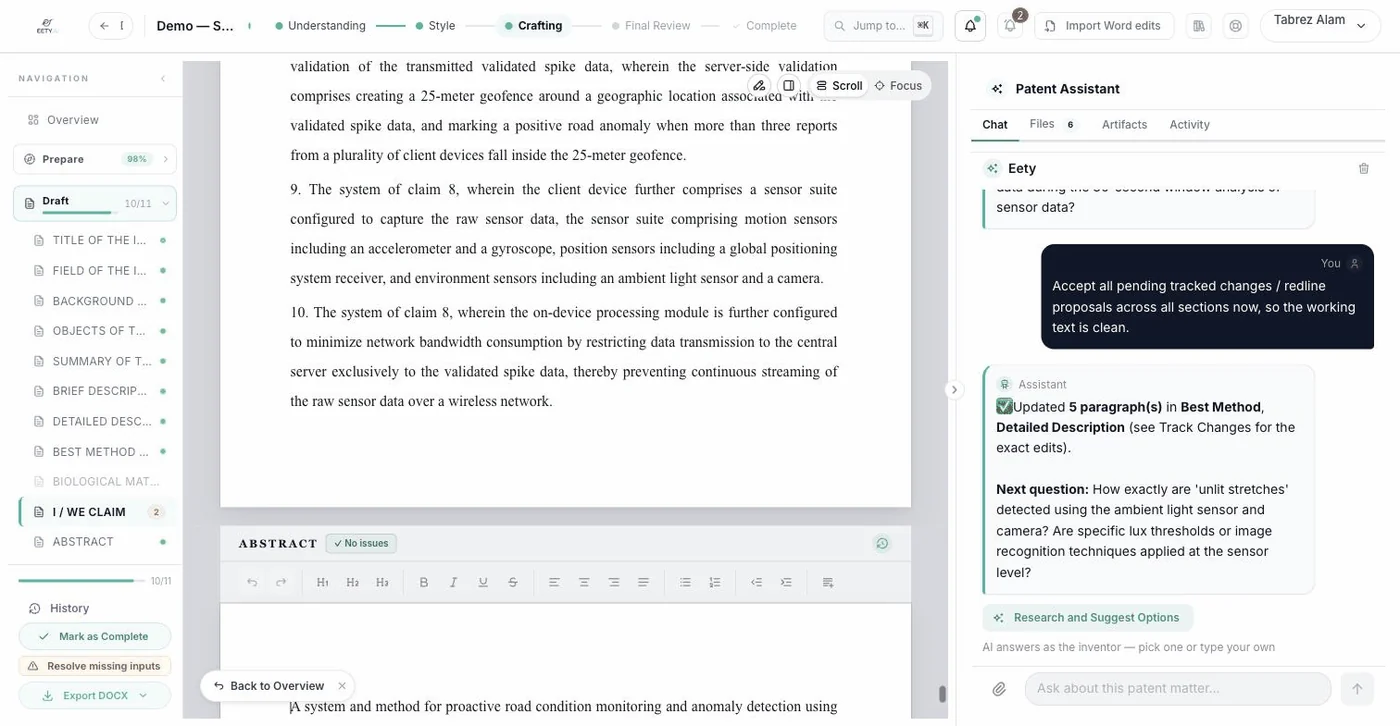
The drafted claim set in the editor, independent and dependent claims numbered in place.

The drafted claim set in the editor, independent and dependent claims numbered in place.

6

Export for your office

The finished draft exports as a filing-ready DOCX in the template of the patent office you picked at the start: USPTO, EPO, PCT/WIPO, UKIPO, or IPO India. The 11-section India Complete Specification is one of the jurisdiction templates, not an afterthought.

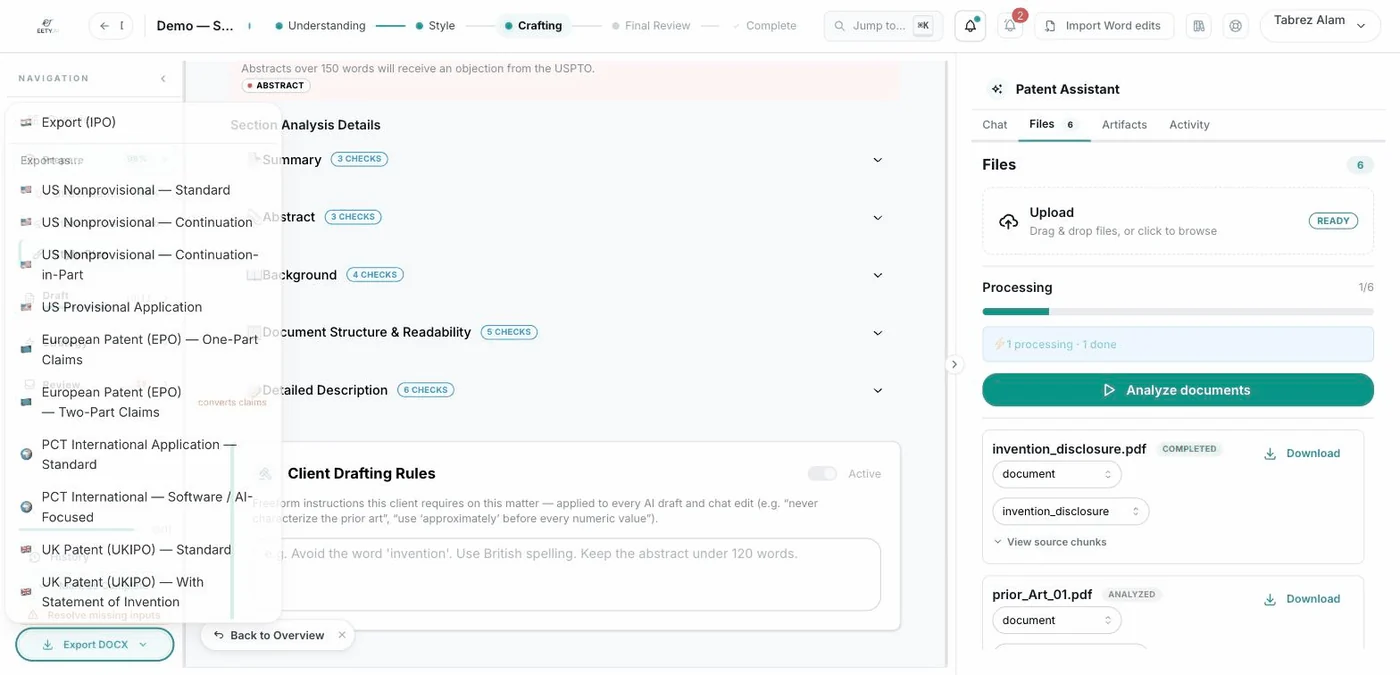
Export in the template of the office you picked: USPTO, EPO, PCT, UKIPO, or IPO India.

Export in the template of the office you picked: USPTO, EPO, PCT, UKIPO, or IPO India.

Why This Is Different

Three claims you can test in your free tokens.

Do not take a marketing page's word for any of this. Each claim below is something you can watch the product do, or refuse to do, on your own matter.

Checkable Claim 1

It refuses to draft too early.

Below 90 percent understanding, eety will not produce a draft. Upload a thin disclosure and watch it hold the line and ask inventor questions instead.

Checkable Claim 2

It flags what it does not know.

Leave one inventor question unanswered and check the draft: the missing fact appears as a flagged inventor input, not as an invented number.

Checkable Claim 3

It draws.

Patent drawings are generated as part of the draft, from the specification itself. Count the figures in your export; no separate drawing vendor involved.

The Word Question, Answered Head-On

Your practice lives in Word. Eety meets it there.

Two colleagues do not need to share one desk to work on the same brief; they need to hand each other clean documents. Eety works with Word the same way, at the artifacts:

  • DOCX out

    Every draft exports as a filing-ready Word document in your office's template.

  • DOCX in

    Attorney edits made in Word import back as a reviewable changeset mapped onto the template sections.

  • Redlines

    Tracked-changes DOCX export, with every edit attributed by name.

5 tokens

$50 per application draft, charged once per matter. Redraft as often as you need at no extra charge.

11 sections

India Complete Specification template, among jurisdiction templates for 5 patent offices.

Drawings in

Patent drawings are generated as part of the draft, not briefed out or billed separately.

10 to 15 hrs

What drafting tools claim to save per application (their claim, not ours). Those claims typically exclude drawings and formalities. Eety's draft includes the drawings.

FAQ

The questions attorneys actually ask.

Does eety work with Microsoft Word? +

Yes, at the artifacts. Your team keeps editing in Word. Eety exports every draft as a filing-ready DOCX, imports Word edits back as a reviewable changeset mapped onto the template sections, and produces tracked-changes redlines with every edit attributed by name. You do not have to move your practice anywhere.

What happens when eety does not know a fact? +

It says so, in the draft. Unanswered facts appear as needs-input placeholders and are routed to the inventor as questions. They stay visibly flagged next to the section they block until someone answers them. They are never silently filled in with a guess.

What is the 90 percent gate? +

Before drafting, eety builds an invention understanding from your documents and scores its own confidence in that understanding. Below 90 percent it refuses to draft and interviews the inventor about the gaps instead. Like a careful associate who reads the file and comes back with questions before writing a word, except the refusal is enforced by the product.

Can it match our house style? +

Upload one reference patent your firm has drafted. Eety distills a style profile from it, covering structure, phrasing, and claim style, and writes the draft to that profile. You can verify this yourself: run the same disclosure against two different reference patents and compare the two drafts.

Who owns the output? +

You do. The drafts, drawings, and exports produced in your account are your work product, prepared for your client. Eety charges for the drafting service (5 tokens per matter) and makes no claim on what you file.

What does a draft cost? +

5 tokens, which is $50 of Eety power, charged once per matter for the drafting service no matter how many times you redraft. Signup comes with 25 free tokens ($250 of work) and no credit card, enough to take several full drafts through the product before paying anything.

The Full Loop

Decide what to patent. Draft it. Verify everything.

Draft the next application with eety.

25 free tokens at signup, no credit card. That is $250 of work, enough to run a full draft and judge the output on your own matter.

Start Free