For IP Heads and R&D Heads · Cloud or on-premise

Your company's patent work, run as one system, with the price on the page.

Two departments, eight roles, one record per invention. Your inventors capture; your IP team decides, searches, drafts and reviews what outside counsel sends back; and the organization console shows who spent what on which matter. No per-seat license, and no annual contract hiding behind a demo call.

See the price list

Harvest $20, search $50, draft $50, counsel-draft review $30, each charged once per matter from one pool. Run it in our cloud or inside your own network.

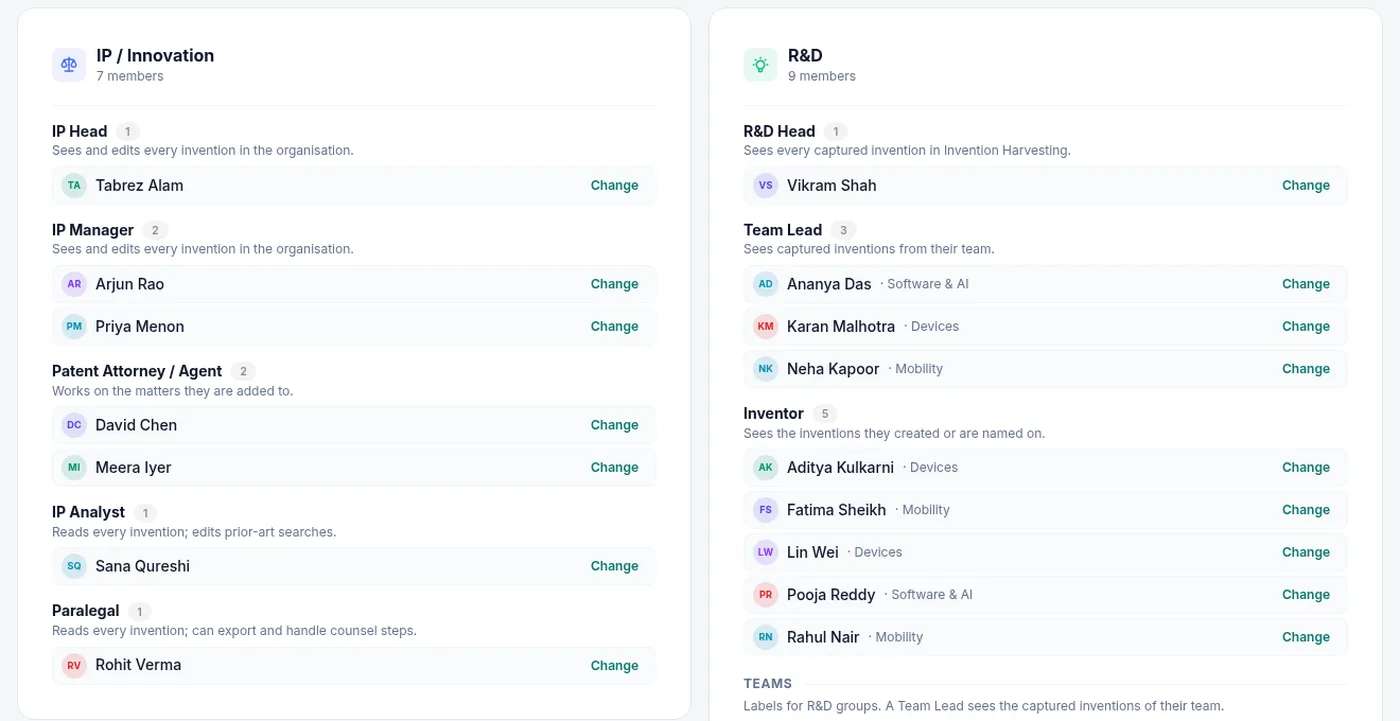
The organization console, Overview tab: People, Tokens (144 of 250), Portfolio (31 inventions) and Needs an admin tiles, a lifecycle funnel from Captured to Filed, and the Needs an admin list with a button on each item.

The organization console, Overview tab: people, the token pool, the portfolio by stage, and what needs an admin, each with a button.

Built for the company

Your company already has two departments that touch a patent. Eety has the same two.

R&D invents and IP / Innovation protects. A patent passes between them, then out to a law firm, then back... a bit like a relay baton, and anyone who has run a relay knows the race is usually lost in the hand-off, not on the straight. So we built Eety around that hand-off, instead of asking your company to work the way a drafting tool expects.

Departments and roles

Two departments, eight roles, teams

IP / Innovation: IP Head, IP Manager, Patent Attorney / Agent, IP Analyst, Paralegal. R&D: R&D Head, Team Lead, Inventor, grouped in teams. An inventor sees their own inventions and the searches and reviews linked to them, read-only. The IP team's areas stay closed to R&D roles.

One record

One matter per invention, with a reference

An invention gets a reference like ACME-2026-0042 the moment it is captured, with your own prefix. The search, the draft, the counsel assignment, the review and the export all sit on that one record. So when someone asks what happened to an idea, there is one place to look.

Lifecycle dashboard

Six stages, and a queue that names the decision

The home screen sorts the portfolio into Captured, Searching, Drafting in-house, Counsel drafts, In review and Ready to file. Underneath, "Needs a decision" lists what is waiting on a person, with the references and one button per item, derived from the data rather than from a pile of notifications.

External counsel

Recorded on the matter, without a seat

Assign a search or a draft to a firm with a due date. See what is out, what is overdue and what came back. The report or the draft lands on the invention's record and you act on it there: run the review, add it as prior art, or just attach it. Counsel work by email, as they always have.

Organization console

Seven tabs for the person who runs the account

Overview, People, Departments, Portfolio, Usage & billing, Activity, Settings. The Overview shows members, the pool, the portfolio by stage and what needs an admin: the numbers an IP Head asks for at the start of every month, already on a screen.

One token pool

One balance, a ledger you can read

Think of a department's disbursement account. One pool, and every charge recorded with who ran it, on which matter, for which service, for how many tokens. Adding a person costs nothing; a charge happens only when someone runs a service.

Invitations

Name, email, department, role, team

Invite one person or a whole list. Each invitation carries the department, the role and, for R&D, the team, so people land with the right view from the day they log in. A stale invitation shows up in the decision queue with a Resend button.

Notifications and audit

Told when it matters, recorded always

An inventor submits, a draft completes, a counsel draft arrives, a review lands: the people on the matter are told. Behind it, an audit log of every action, and exported redlines carry the name of whoever made each edit.

Deployment

Our cloud, or your own servers

Eety Cloud, hosted on Google Cloud. Or Eety On-Premise: the application, workers, database and every file inside your network. Three things leave; we say exactly which.

Explore deployment →
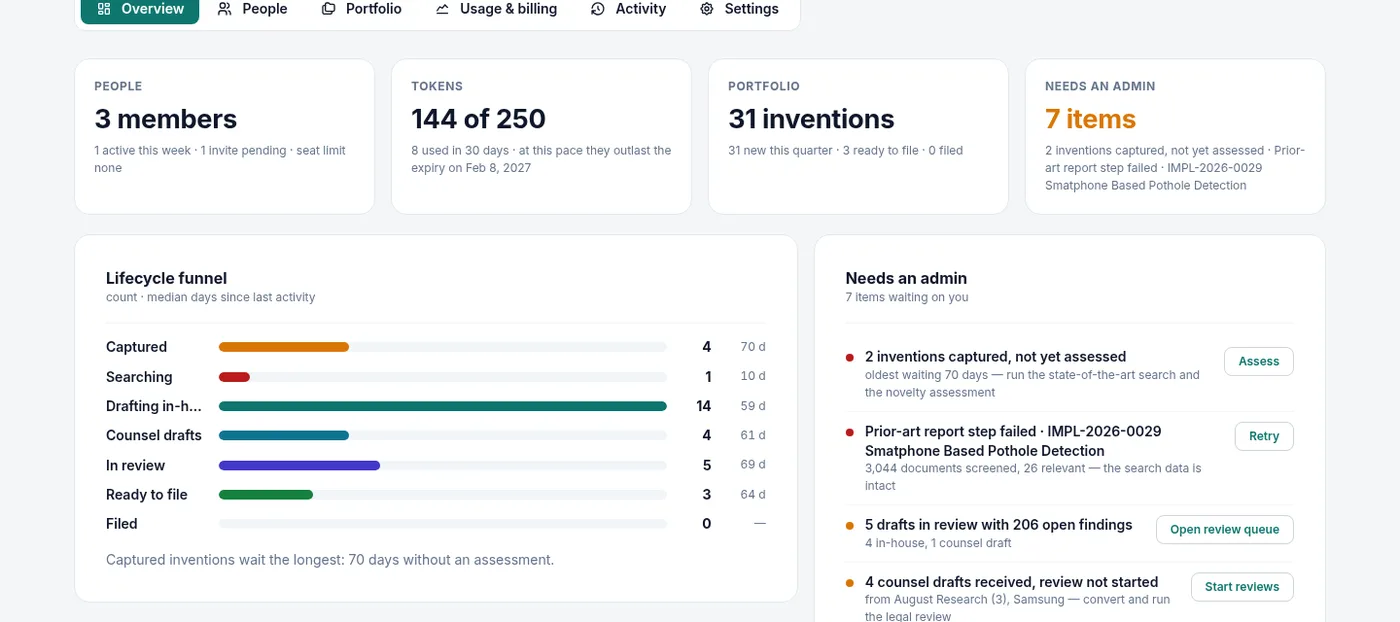
The Departments tab of the organization console: IP / Innovation with IP Head, IP Manager, Patent Attorney / Agent, IP Analyst and Paralegal, each with a one-line description of what they see; R&D with R&D Head, Team Leads tagged by team and Inventors tagged by team.

The Departments tab: two departments, eight roles, teams inside R&D. Each role says in one line what it sees.

The procurement question

The price is on the page. That is the point.

You know the restaurant that prints "market price" next to the lobster? It is not really expecting a new customer to order it... it is expecting you to ask, and then feel a little awkward about asking. Enterprise patent software typically runs $30k to $100k+ per year, and the actual number appears only behind a demo call.

Actually, let me back up a step. Nobody minds paying for software that does the work; what wastes a quarter is not knowing the number until several meetings in. So we publish ours. Harvesting is $20 per invention, a prior-art search $50, a full draft $50, a counsel-draft review $30, and the packs are on the pricing page with the per-token rate shown. No per-seat license, no annual contract. Read the numbers this afternoon; if procurement wants a call anyway, we do those too :)

Industry norm

$30k to $100k+ per year

What enterprise patent software typically runs, quoted after a demo call. Their model, not ours.

Eety

$20 / $50 / $50 / $30 per matter

Harvest, search, draft, counsel-draft review. Charged once per matter per service, from one pool. Published at eety.ai/pricing, checkable right now.

One loop

Decide what to patent. Search it. Draft it. Check what comes back.

If you sit on an IP committee, you already run this loop by hand: triage the disclosures, search the keepers, assign the drafting, check what the firm sends back, probably with a spreadsheet somewhere in the middle of it. Your team runs the same loop in Eety, on one record per invention, with each step priced per matter.

The whole loop on one invention: 15 tokens ($150) with the search, 10 tokens ($100) without it. Harvest 2, search 5, draft 5, counsel-draft review 3. Each service is charged once per matter, so redrafts and re-reviews on that matter cost nothing more.

Organizations start from a pool their admin provisions. To be upfront about it: the 25 free signup tokens are for individual accounts. An organization account starts at zero, and the admin buys a pack into the shared pool; every charge from then on is in the ledger with a name and a matter reference.

The 30-day pilot

Run it on your own inventions before you decide.

A pilot is a month of real work, not a slide deck; a test drive on your own roads rather than the dealer's track. You bring real disclosures and a few of your own granted patents, and at the end you read the ledger and the audit trail yourself. At list rates the ten harvests, two searches and three reviews come to 39 tokens, from a pool your admin provisions. Nothing renews... so there is nothing to cancel.

Week 1

Your organization, set up

Departments and roles switched on, people invited by name, email, department, role and team, your reference prefix chosen, and five of your granted patents ingested into the library so drafts follow your house style.

Weeks 2-3

Real work on real inventions

Ten disclosures harvested by your inventors and assessed by your IP team. Two prior-art searches on the strongest. Three counsel drafts you already have, reviewed and returned as redlines.

Week 4

The read-out

The dashboard, the ledger and the audit trail open on the table. What the verdicts said, what the searches found, what the reviews caught, and what each step cost, by name and by matter.

Security

Documented in the open, like the pricing.

Tenant keys on every customer table. A per-matter ledger and an audit log of every action, department and role access, and Google Cloud terms for the model. We show no badges we have not earned; a DPA, the sub-processor list and a completed security questionnaire are available on request.

Read the security page →
Tokens

One token is $10 of Eety work. Packs bring the rate down.

It works like a transit card for the whole department: your admin loads a pack into the organization's pool, and everyone taps from the same balance. Tokens are valid for 180 days from purchase; nothing renews on its own, and the same prices apply in the cloud and on-premise.

Starter

$250

25 tokens at $10

Growth

$1,000

112 tokens at $9

Scale

$5,000

667 tokens at $7.50

On-premise

Talk to us

A services agreement plus the same tokens

FAQ

What IP Heads usually ask us.

Who sees what inside our organization?+

Two departments, eight roles. IP Head and IP Manager see and edit every invention; a Patent Attorney / Agent works the matters they are added to; an IP Analyst and a Paralegal read everything. On the R&D side, the R&D Head sees every captured invention, a Team Lead sees their team's, and an Inventor sees only the inventions they created or are named on, with the linked searches and reviews, read-only. Owner and Admin sit on top as account roles, and they are the only ones who open the organization console.

Do our outside counsel need accounts?+

No. Counsel are recorded on the invention's matter, not licensed as users. You assign a search or a draft to a firm with a due date, see what is overdue on the dashboard, and receive the report or the draft onto the same record. They keep working by email, as they always have.

How are tokens shared across the organization?+

One pooled balance, provisioned by your admin. When anyone runs a service, the charge comes out of the pool and lands in the ledger: who, which matter, which service, how many tokens. Harvesting is 2 tokens, state of the art 1, a prior-art search 5, a full draft 5, a counsel-draft review 3, each charged once per matter; so a colleague redrafting on the same matter costs the pool nothing. The whole loop on one invention is 15 tokens ($150) with the search, 10 ($100) without.

Do you support SSO and role-based access?+

Role-based access is built in: departments, roles and teams decide what each person sees, and the Owner and Admin manage people, billing and the pool. For SSO, honestly, bring your setup to the demo and we will walk through what fits, rather than promise a checkbox here.

Is our data isolated from other organizations?+

Yes. Every customer table carries a tenant key, so your matters, documents, drafts and ledger belong to your organization and are not visible to any other. Companies whose policy is "internally hosted only" can run Eety on-premise, with the application, workers, database and files inside their own network. The security page lists the controls we actually run.

How do we run a pilot?+

Book the demo and we set up a 30-day pilot: week one, your organization, departments and five granted patents into the library; weeks two and three, ten disclosures, two searches and three counsel drafts; week four, the read-out with the ledger and the audit trail open. Organizations start from a pool their admin provisions. The 25 free signup tokens are for individual accounts, so a single attorney can still try the services today at pmc.eety.ai.

Book a demo

See it in your company's context.

A focused session around your docket: departments and roles, the dashboard, the counsel desk, the pool and the ledger, and the four services on an invention like yours. The numbers were never meant to be the hard part of this conversation; you have already read them, so the call can be about the work. I am still not sure every buyer wants the price this early... I am fairly sure the ones who run a department do.

Cloud or on-premise