"It generated the full draft in 30 seconds!"
That was a founder I met, showing me his AI patent tool with genuine excitement. He uploaded a 2-page invention disclosure, hit a button; within half a minute there was a 12-page patent application on the screen. Claims, abstract, detailed description. All of it. He was beaming.
I asked him one question: "Can you tell me what is the most novel aspect of this invention?"
He read the claims for a while. Then he said… "I think it's all here somewhere."
That is the problem. Speed was never the bottleneck in patent drafting. Understanding was. And a tool that starts writing in 30 seconds has, by definition, skipped the hard part.
What the tool actually did in those 30 seconds
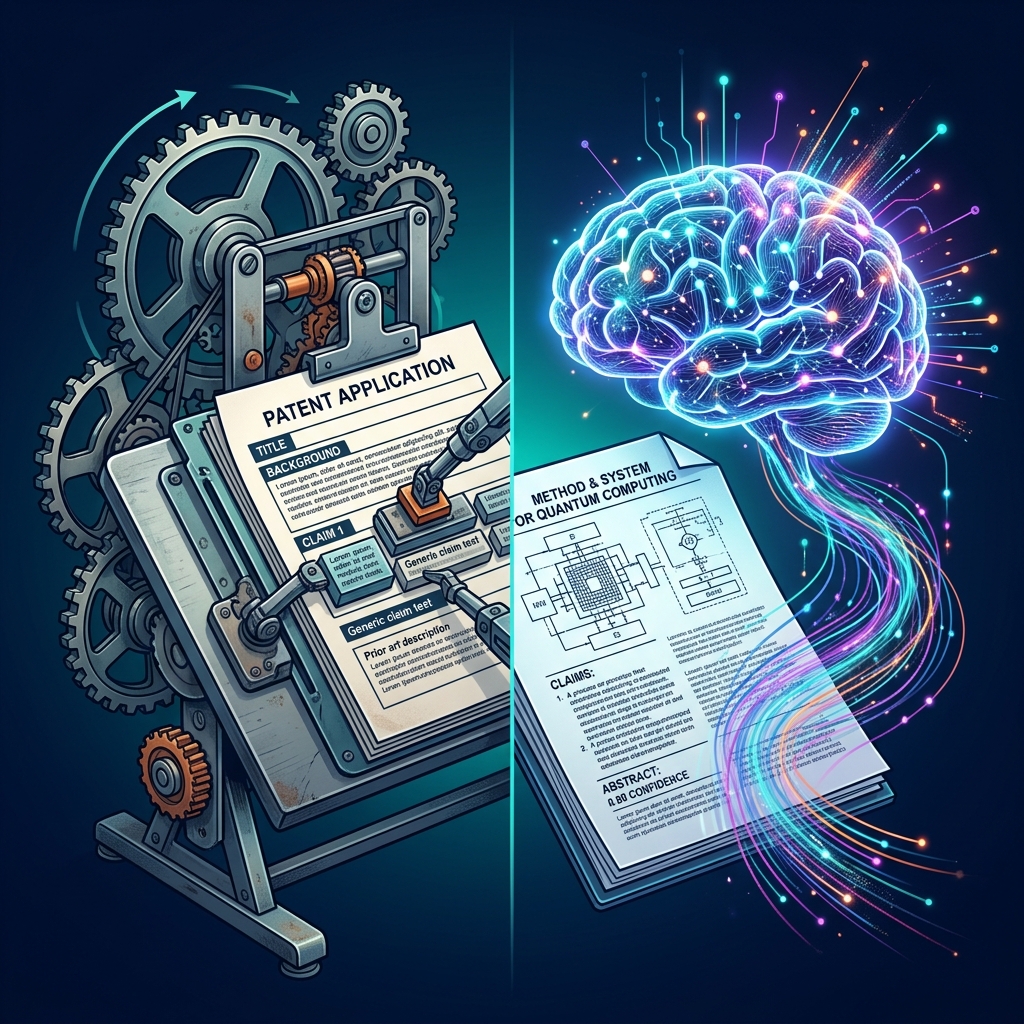
It scanned the disclosure for nouns. The system, the method, the device, the processor, the network. It found what appeared to be the key inventive step, the thing mentioned most frequently, or mentioned first. It then filled those terms into sentence structures it had seen in hundreds of thousands of patents before.
The output is grammatically flawless; technically dense; it reads exactly like a patent. But when you dig in, you find:
- Claims that cover what's described rather than what's inventive
- Dependent claims that add structural limitations when functional language would give broader coverage
- A description that paraphrases the disclosure rather than building the evidentiary record
- No interrogation of what was genuinely novel vs. what your inventor assumed was novel
This is not a bug you can fix with a better prompt. It is what happens when you build a system that models patent language without ever asking it to understand the invention. These are not the same thing… not even close.
"Imagine a junior associate who joins your firm, gets handed a disclosure, and starts drafting claims before even reading it properly, because they've seen enough patents to know what claims are supposed to look like. That's your AI template tool."
What a patent claim actually is
A claim is not a description. It is a legal boundary. And drawing that boundary requires someone (or something) to first understand where the prior art ends and where your invention begins.
Before a skilled attorney writes a single word, they are silently asking questions that most AI tools never ask:
- What is genuinely novel here, not just new to the inventor but new to the field?
- Which components are essential to the novelty vs. just incidental to this embodiment?
- How broad can independent claim 1 go before it reads on art we already know about?
- What alternative implementations exist that still practice the core concept?
- Where are the knowledge gaps in this disclosure that need to be filled before we start?
None of these are answerable by scanning for keywords. They require building a conceptual model of the invention, understanding it the way an engineer who needed to replicate it from scratch would understand it.
So what does eety.ai do differently?
When I was building eety.ai, I kept thinking about something I noticed in my own work. Every time I tried to rush from a disclosure to a draft, even with my own understanding of the problem space, the output was weaker. The claims were narrower than they needed to be; the spec didn't anticipate the right questions; the dependent claims felt like padding.
The quality improved dramatically when I slowed down and built a model of the invention first. Mapped the components. Identified the gaps. Asked the inventor the questions that the disclosure hadn't answered.
So that is exactly what eety.ai does before it writes a single word. The Brain runs a 15-point deep analysis of your invention:
Inventive concept, technical problem, solution mechanism, novelty assessment, component mapping, interaction tracing, alternative embodiments, gap detection, among others. When gaps are found, the system does not fill them with assumptions; it surfaces them as targeted interview questions, framed the way an engineer who needs to build your invention would ask them.
A reasonable question at this point: if the Brain is reading the disclosure to build this understanding, what happens to that raw document afterward? Where does it go? I have been asked this in every single demo I have done. The answer is worth understanding properly; not with a policy link, but with an actual explanation of the architecture. How eety.ai Protects Your Client's IP from Training Data Leaks covers exactly what the Brain does with that data; and what happens to your disclosure after it has been read.
Only when this model reaches sufficient confidence does drafting actually begin.
That confidence gate is not an arbitrary restriction; it is the most important quality control mechanism in the system. I wrote a separate piece about it after a user asked me to remove it: The 90% Problem: Why eety.ai Asks Before It Drafts. The conversation that prompted it explains, better than I could in a product description, why the gate has to exist.
"Think of it like that one person on your team who refuses to proceed until they fully understand what they've been asked to do. Annoying sometimes… but their output is always the best in the room."
The difference shows up where it matters
When drafting is grounded in a real invention model, not surface-level pattern matching, the output is different in ways that matter at the USPTO and in court:
- Independent claims reflect what is actually inventive, not what happened to be mentioned first in the email
- Functional language is used where it gives broader coverage; structural language where specificity is needed
- The specification builds an evidentiary record that supports the claims sitting next to it
- Dependent claims add genuine protection layers, not arbitrary narrowings of the independent
- The written description anticipates questions from prosecution, before prosecution even begins
A simple test you can run right now
Pick any AI patent tool. Upload a real invention disclosure. Then ask it this: "What is the single most novel aspect of this invention, and why doesn't it read on a prior art reference you can name?"
If it gives you a technically grounded, coherent answer that you would actually agree with after thinking about it, it understood your invention. It has a brain.
If it gives you a well-written paragraph that is, on reflection, just the keywords from your disclosure rearranged into patent-shaped sentences… it's a template machine. A very eloquent, very fast, very confident template machine :)
eety.ai will answer that question. Not because we built a more sophisticated template. But because before the first word of your patent is written, the system has been thinking about your invention. Not just reading it.
The brain is where quality drafting starts. But understanding the invention is only the first gate. What happens after; how the tool handles verification, personalisation, memory, and control across the full life of a matter; is a separate conversation. One I laid out in full in what I ended up calling the CARE framework: The CARE Framework: What Trustworthy AI Actually Looks Like in Patent Drafting.
See It In Action
Watch eety.ai build a complete invention model before drafting a single word.
Try It Free →