Listen, a patent is a bargain; you publish the idea, and in exchange you get the right. Until the filing goes in, though... the idea is only worth something if nobody else has it. So this page tells you, in plain words, what we do with yours: where it is stored, who can open it, which three things leave the network, and which badges we do not have. That last list is longer than we would like :)
A DPA, the sub-processor list and a completed security questionnaire, all on request.
Every security page is a list of promises. Fine. But a promise is only useful if you can check it, so everything below is something you can see in the product, ask us to show you in a demo, or read in Google Cloud's published terms. The second list matters just as much; it is the badges other products print that we do not have, said plainly now so that a questionnaire answer does not surprise you halfway through procurement.
Every customer table carries your organization's key, and every query filters on it on the server. Inside your organization, the finer locks are departments and roles; they decide who opens what.
A per-matter ledger of what was charged and by whom, plus an audit log of every action. So when someone asks who changed claim 3, you have an answer... not a guess.
Google Gemini, called through Vertex AI, under terms that exclude training on your prompts. On-premise, it can run in a Google Cloud project of your own.
The application, the workers, the database and every file can run inside your network. We tell you exactly what still leaves; something always does.
What we do not claim
No SOC 2, no ISO 27001
Not today. Instead of printing a badge, we answer your security questionnaire on request.
No SAML, SCIM or enforced MFA
Sign in with Google is available. Single sign-on, provisioning and enforced multi-factor are not available yet.
No "your data never leaves"
That is not true of any AI product, ours included. Three things leave; the diagram below names all three.
No "Gemini stores nothing"
Google's retention and abuse monitoring are Google's policy, not ours. What we can say is narrower: not used to train, per Google Cloud terms.
Picture the deployment as an office building with one front door and three outside phone lines. Your people come in through the door, with a badge. Everything you upload, draft and export stays inside the building, the way papers stay in a locked office when the lights go off. The three lines are the AI model, the search engines, and the public web pages a prior-art search reads. So here is the walk-through, one step at a time.
A PDF, a Word file, images, audio or a sketch travels from your browser to the application over HTTPS. The request carries a signed token that names you and your organization; without one, nothing is accepted.
The file lands in the file store and its row lands in the database, both keyed to your tenant and to the matter. On Eety Cloud that file store is Google Cloud Storage, with customer-managed encryption keys supported; on-premise, it is your own file store. There are no public URLs. A file is served only to a signed-in member of the matter.
Whenever a step needs the model (to understand the invention, draft a section, review a draft or plan a drawing), the text, documents, images and audio that step needs go to Google Gemini through Vertex AI, per request, under Google Cloud terms that exclude training on your prompts. Generated drawings come back from Google's image model. The answer is written to your record. The conversation history lives in your database, not at Google.
A state-of-the-art search or a prior-art search sends search strings and publication numbers to patent and literature databases through SerpApi. Never the disclosure, never the draft. Then the literature and known-art steps fetch the public web pages those results point to, directly, the way your own browser would.
OCR, Office conversion, and the Word, Excel and PDF files you export are all produced inside the deployment. The redline you send back to counsel never passes through a third party.
In transit
Browser to application over HTTPS, terminated by nginx with the deployment's own certificate. Application to Google and SerpApi over HTTPS.
At rest
On Eety Cloud, Google Cloud's storage encryption applies, and customer-managed keys are supported on the file store. On-premise, encryption at rest is whatever your disks and database do; we do not claim a cipher we do not control.
Nothing to eety
An on-premise deployment sends no telemetry, usage data or license ping to eety. There is no arrow to us on the diagram because there is none in the code.
Think about a shared office building. Nobody keeps the tenants apart with a polite sign asking people to stay on their own floor; the building uses locks, and the elevator stops only where your badge says it can. Eety works the same way. Every customer table in the database carries a tenant key, every request carries a signed token that names the person and their organization, and every query is filtered by that key on the server before any row is returned. So a bug in a screen cannot show you another organization's matter... the rows never reach the screen.
Inside the organization, the locks get finer. Two departments, eight roles. An inventor sees the inventions they created or are named on, plus the searches and reviews linked to them, read-only. A team lead sees their team's captured inventions. And the IP team sees everything in its own areas, while those areas stay closed to R&D roles. Outside counsel are recorded on the matter and never log in. The full who-sees-what table is on the platform page.
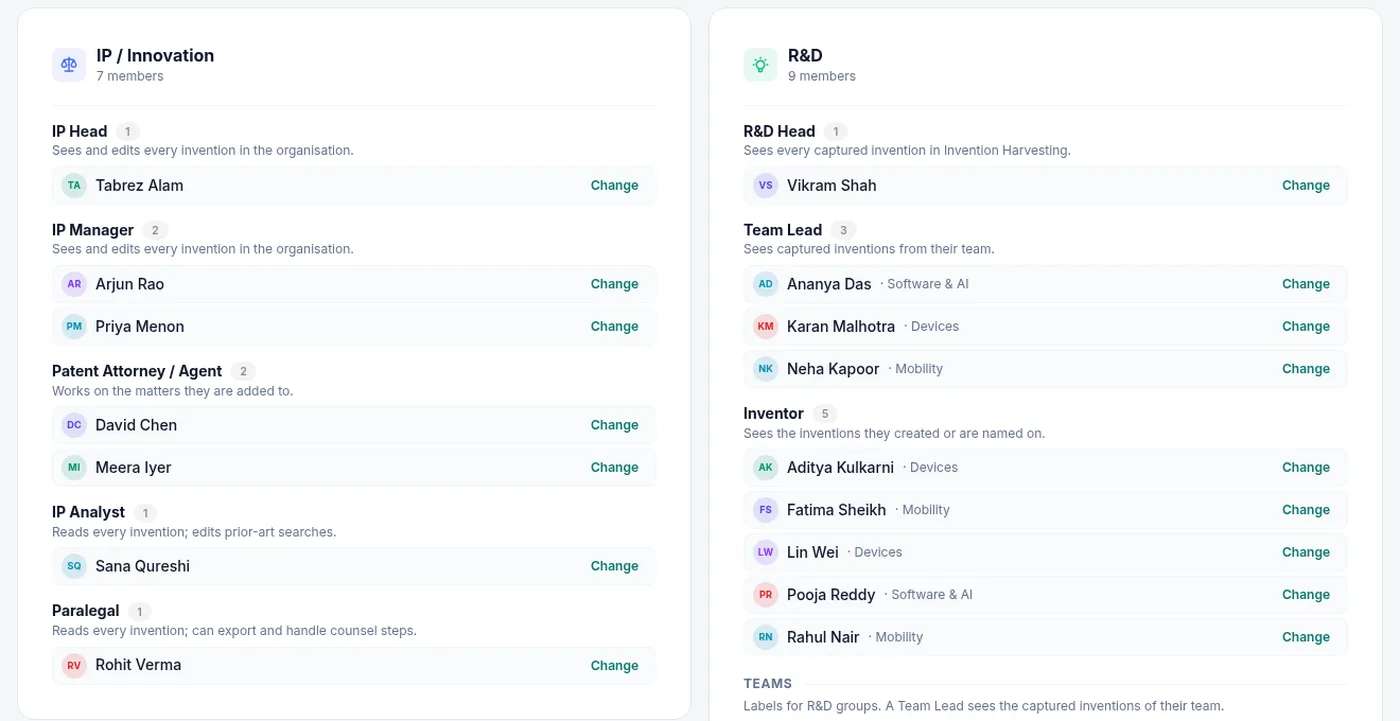
The Departments tab: two departments, eight roles, teams inside R&D. Switch it on, and what people see follows their role.
Sign-in and sessions
Email and password, or Sign in with Google. Passwords are stored as bcrypt hashes, never in a readable form. Sessions use signed tokens, and the application signs you out after 15 minutes without activity.
Matter membership
A matter has members. Roles that work "own or assigned only" open a matter when they are on it, and a file is served only to a signed-in member of its matter. Suspended members lose access at once.
What is not here yet
SAML single sign-on, SCIM provisioning and enforced multi-factor authentication are not available today. If your policy requires them, tell us in the demo request. The questionnaire will give you the same answer you just read here.
Fair question, and usually the one that decides the meeting. Eety's AI is Google Gemini, called through Vertex AI. There is no eety model trained on customer content, and the terms that govern what Google does with a request are Google Cloud's published terms, which exclude training on your prompts. Here is the whole arrangement... including the part we cannot promise.
The text, documents, images and audio that one AI step needs: the disclosure to understand it, the understanding and the section brief to draft, the draft to review, the claims to plan a figure. Each request is sent and answered; the answer is stored on your record. Generated drawings come back from Google's image model.
Google Cloud's terms for Vertex AI, which exclude the use of your prompts and responses to train Google's models. On Eety Cloud the calls run in eety's Google Cloud project, in a region where Gemini is available. On-premise they can run in your own project, so the terms, the quota, the logs and the bill are between you and Google.
Delivers the service. By default your matter content is not used to train or tune anything; the privacy policy allows it only for accounts that opt in explicitly, and nothing opts in on its own. The drafting library learns your house style from the granted patents your own organization approves, inside your tenant, for your tenant.
That Google keeps nothing. Google's retention and abuse monitoring for Vertex AI are Google's policy and are described in Google's documentation, not ours. We also do not promise a named region for the model. If your policy needs either, the honest route is your own Google Cloud project, where you set both.
A ship keeps a logbook. Not because anyone suspects the captain; because months later, somebody will ask what happened at 03:00, and memory makes a poor witness. Eety keeps two logs. The matter ledger records every charge against the invention it belongs to (harvesting, state of the art, a prior-art search, a draft, a counsel-draft review), each with the person who ran it. The audit log records every action on the organization's records, with the actor and the time.
Actually, let me back up a little; the accountability does not stop at the edge of the product. The tracked-changes Word redline you export names who made each edit, so the firm sees your attorney's changes under your attorney's name and the review's under its own. And the reference, something like ACME-2026-0042, stays on every file name, so a year from now the record can still be found.
Ledger
Per matter, per person
Audit log
Every action, actor, time
Named edits
In the Word redline
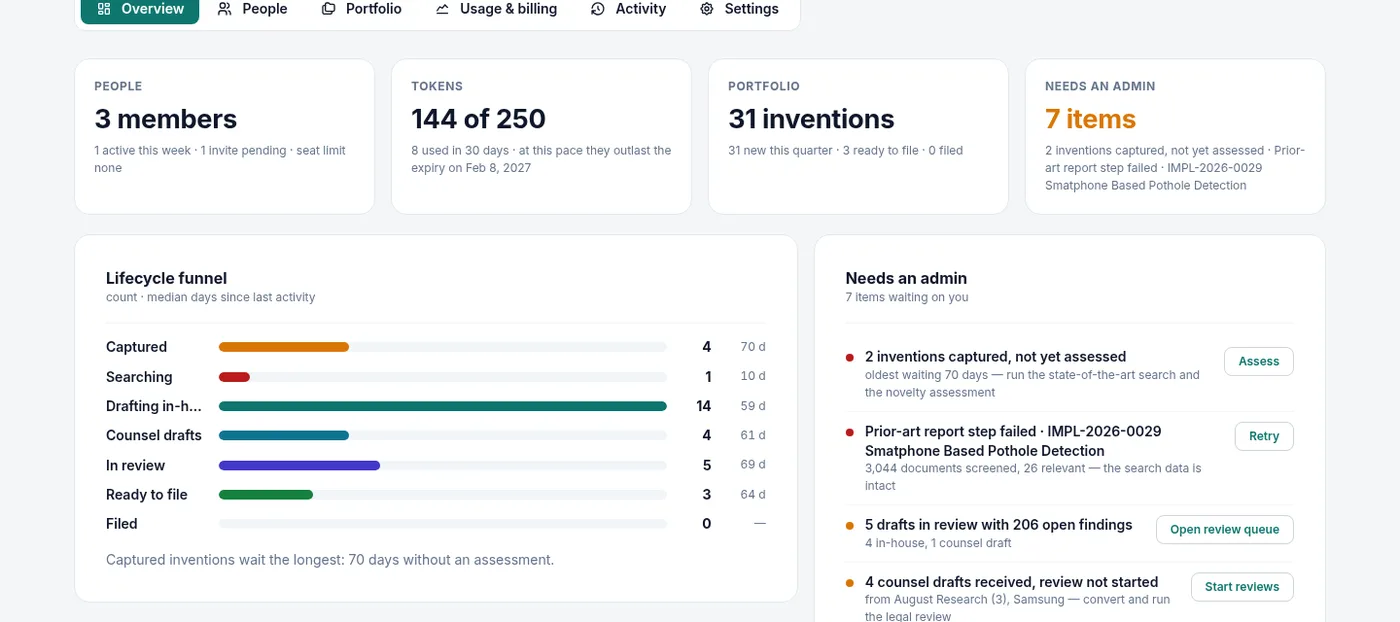
The organization console: the token pool at a glance, with Usage and billing and Activity tabs for the ledger and the log behind it.
A capture of the organization's Activity tab: one line per action, with the member, the matter reference and the time.
Capture scheduled with the media phase; the tab exists in the product today.
Some companies will not let an unfiled invention leave the building; until the filing date, the secret is the asset, and they treat it that way. For them, Eety runs on-premise: everything except the AI model and the search engines runs on your side. The three outside lines on the diagram above are the same in both deployments. What changes is who owns the building.
Eety Cloud
Hosted by eety on Google Cloud.
Tenant keys on every customer table, a per-matter ledger and an audit log of every action. Files in Google Cloud Storage, customer-managed keys supported. Backups run by eety. Sign up today and start on free tokens.
Eety On-Premise
The application, the workers, the database and every file, inside your network.
Disclosures, drafts, search results, reports, the ledger and the audit log live in your database and your file store, backed up by you. Document processing happens inside the deployment. Gemini can run in your own Google Cloud project. Nothing is sent to eety.
What we do say
Runs on your infrastructure. Your documents, drafts, reports, search results and audit log stay in your database and your file store. Nothing is sent to eety.
What we do not say
"Air-gapped", "your data never leaves your network", "private AI model", "SOC 2 certified". None of those is true today, so none of them is on this page.
Read the detail
The deployment page covers the host footprint and the outbound rules. What leaves your network lists every endpoint and what it receives.
A data processing agreement. The sub-processor list, which is also on the privacy page: Google Cloud and Vertex AI, SerpApi, Brevo for email, Razorpay for payments, Google sign-in and analytics. A completed security questionnaire in your format. The store-by-store list of where Eety Cloud data lives today. Ask in the demo request, or write to security@eety.ai.
Found a security issue? Email security@eety.ai with the detail. We do not pursue researchers who report in good faith.
No. Every customer table carries a tenant key, and every request carries a signed token that names your tenant. Queries are filtered by that key on the server, not in the browser. Inside your organization, departments and roles decide who sees what: an inventor sees their own inventions and the linked searches and reviews, read-only; the IP team's areas stay closed to R&D roles.
Eety calls Google Gemini through Vertex AI under Google Cloud terms that exclude training on your prompts. The text, documents, images and audio of each AI step are sent per request. We do not say that Google stores nothing, because Google's retention and abuse monitoring are Google's policy, not ours. On-premise, the calls can go through your own Google Cloud project. Eety itself does not use your matter content to train models by default.
On Eety Cloud, the application, database and files run on Google Cloud, hosted by eety, and files are in Google Cloud Storage with customer-managed keys supported. Gemini runs in a region where it is available; we do not promise a named region on this page. On-premise, the application, workers, database and files run on your servers. Ask us for the current store-by-store list.
Not today. We list the controls we actually run, we answer security questionnaires on request, and we provide a DPA and the sub-processor list. The on-premise option exists for companies whose policy is "internally hosted only".
Sign in with Google is available, and email sign-in uses passwords hashed with bcrypt, signed session tokens and a 15-minute inactivity logout. SAML single sign-on, SCIM provisioning and enforced multi-factor authentication are not available today.
Before anything else, export your drafts and reports; Word and Excel exports are yours to keep. Then write to privacy@eety.ai. Deletion is carried out on written request and completed within 30 days, with backups aging out on their retention schedule, except where the law requires retention.
Bring your security questionnaire. We will walk the data flow on a live matter, open the ledger and the audit log, and show you what an inventor, an R&D head and an IP head each see. If the answer to something is "not yet", that is the answer you will get. We are not sure this page will ever feel finished; we are sure it is honest, and for now that will have to do.