Your inventors submit. Your IP team decides what deserves a patent, searches the prior art, drafts, reviews what outside counsel sends back, and gets the filing-ready application out of the door; all of it on one matter, with one ledger and an audit trail behind every step. Run it in our cloud, or inside your own network.
Every service has a public price. Individual accounts start with 25 free tokens, and no credit card.
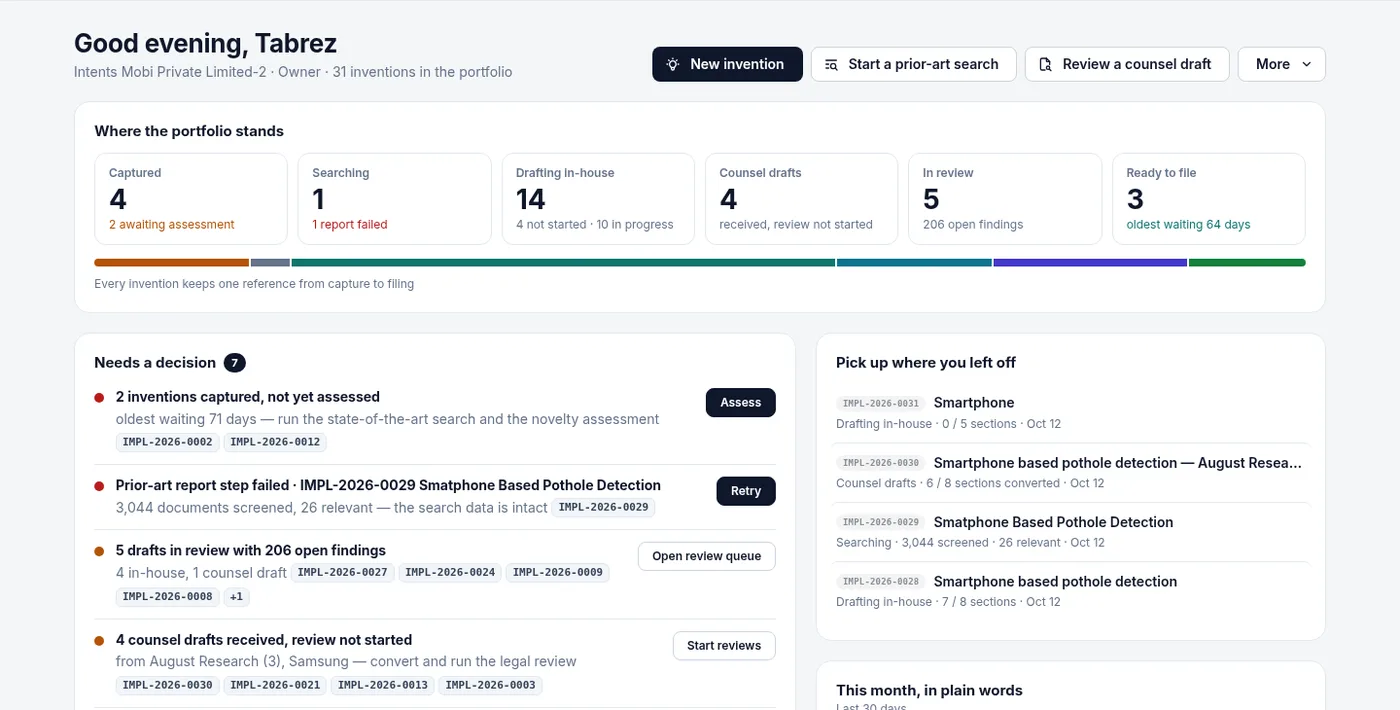
Where the portfolio stands, in one screen
1
Record per invention
One reference, like ACME-2026-0042, from capture to filing.
5
Services, one balance
Harvest, search, draft, review, counsel. Each priced per matter.
5
Patent offices
USPTO, EPO, PCT/WIPO, UKIPO, IPO India. 11 drafting templates.
8
Roles, 2 departments
IP / Innovation and R&D. Inventors see only their own.
2
Ways to deploy
Eety Cloud, or on-premise inside your own network.
Think about the file a hospital keeps on a patient. It opens at admission, and every specialist writes on that same file; nobody starts a fresh one because they sit in a different wing. An invention deserves the same. It gets its reference the moment an inventor captures it, and keeps that reference through the search, the draft, the review and the export. The dashboard sorts the whole portfolio into six stages and tells you, in plain words, what is waiting on a decision. And if a law firm does the search or the draft, their work is attached to the same record and goes through the same review.
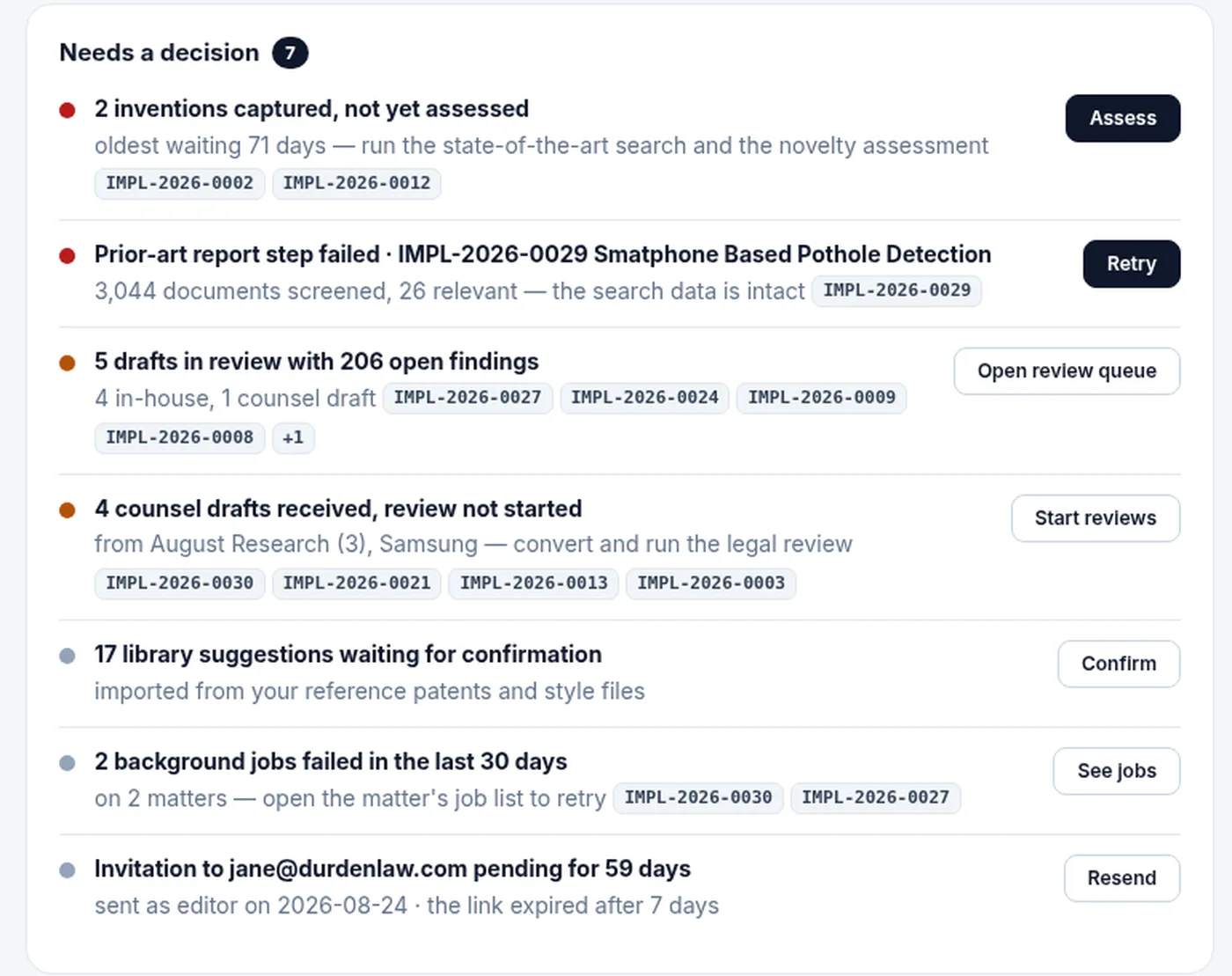
Needs a decision: worked out from the data, never from a notification. One button per decision, and a reference on every item.
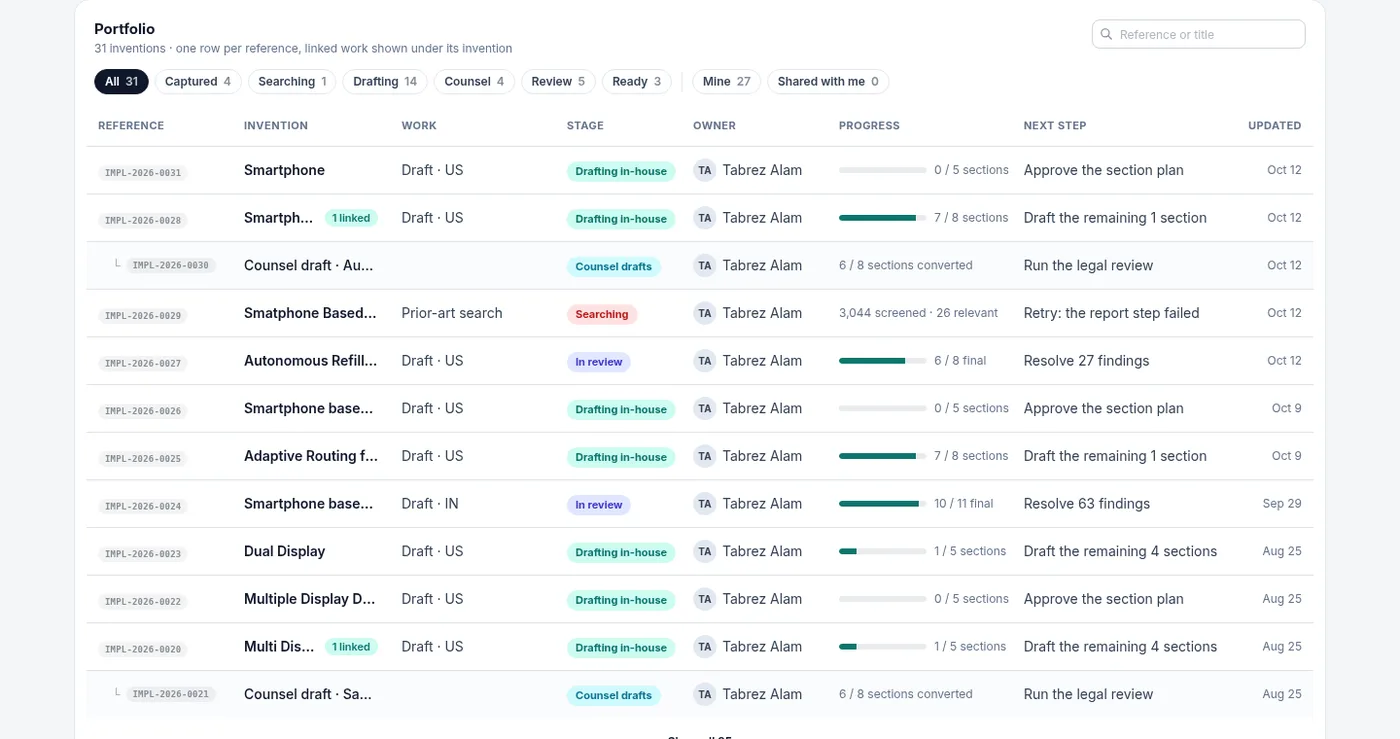
The portfolio: one row per reference. A search and a counsel draft sit under the invention they belong to.
Six stages are live today. Filed is reserved for prosecution, which comes next.
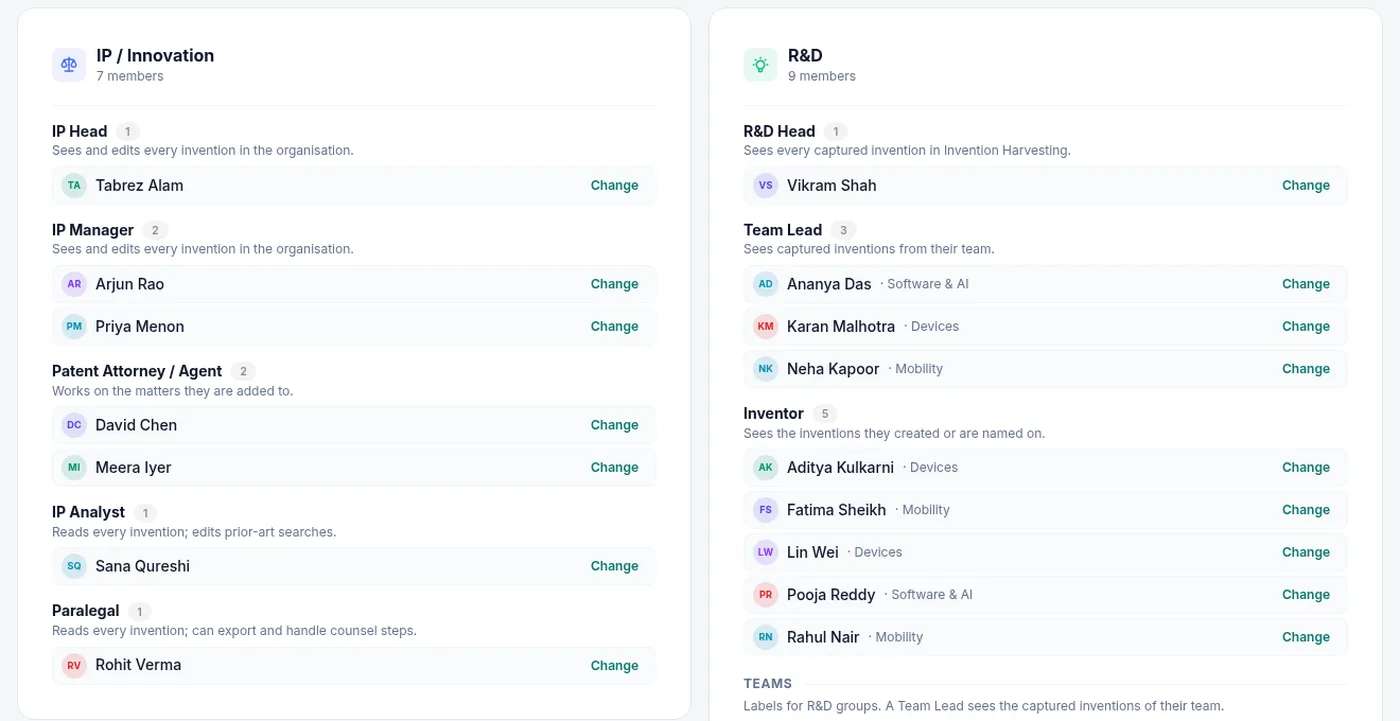
Any company that files patents has two groups who touch them: the people who invent, and the people who protect. So Eety has the same two departments. R&D captures inventions and sees how they progress; IP / Innovation decides, searches, drafts, reviews and files. Owner and Admin sit on top as account roles.
An inventor sees their own inventions, and the searches and reviews linked to them, read-only. A team lead sees the captured inventions of their team, while the IP team sees everything. Counsel never log in; their work is recorded on the matter.
| Role | Inventions | Searches | Drafts | Reviews | Counsel |
|---|---|---|---|---|---|
| IP Head, IP Manager | |||||
| Patent Attorney / Agent | |||||
| IP Analyst | |||||
| Paralegal | |||||
| R&D Head | |||||
| Team Lead | |||||
| Inventor |
The Departments tab: two departments, eight roles, teams inside R&D. Switch it on, and what people see follows their role.
The whole portfolio, and what is waiting on you
Six stage tiles, the decision queue and every reference. New invention, prior-art search and new draft are one click away, and the organization console shows the funnel, the workload by member and the token ledger.
Every captured invention, and where it went
The R&D Head sees every invention the department captured and its stage. Team leads see their own team's. Nobody in R&D sees the IP team's queue, the library or the counsel desk.
"Where your inventions stand"
An inventor captures an invention, answers Eety's interview, and presses Submit to IP team. From then on they can open their own invention, plus the search and the review on it, read-only... and nothing else.
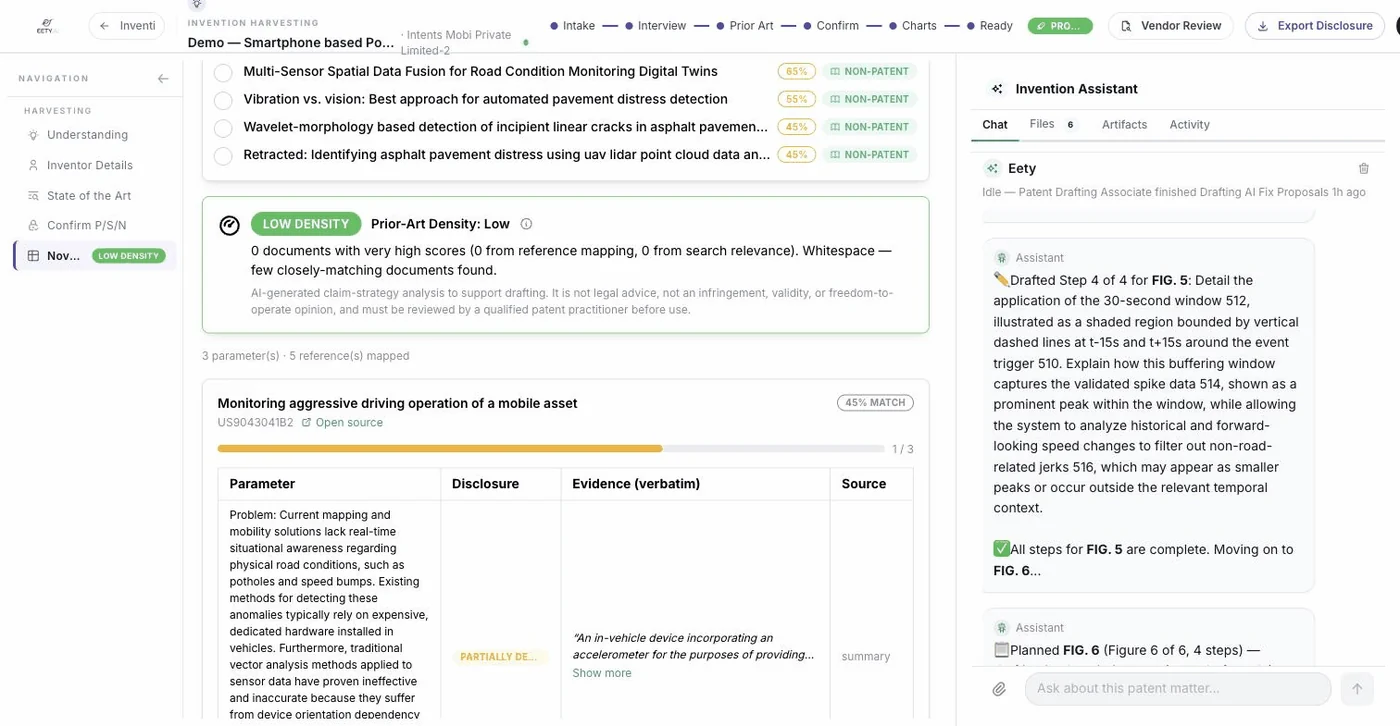
Nobody pours a foundation before someone has checked the ground; the engineer digs and tests, and only then does the builder spend real money. Most companies draft patents the other way round. They pick a disclosure, spend the money, and find out much later that the ground was already crowded. :( So harvesting is the soil test. An inventor captures the idea, Eety interviews them until it understands the invention at 90 percent, runs the state-of-the-art search, and returns a prior-art density verdict: Low, Medium or High, with every reference saying where it came from.
It costs you $20 to learn whether the invention deserves a search and a draft. And when the verdict says go, you promote it to a draft with an assignee in one step, on the same record.
$20
2 tokens, once per invention
Low / Med / High
Density verdict
Before
You spend drafting money
The density verdict: a Low, Medium or High call, each reference carrying its provenance label.
A good accountant does not just hand you the total. She shows you the workings, so you can check the one line you doubt; a search should work the same way. Eety reads the invention and writes out what it understood: domain, problem, solution, novelty. You confirm it and approve the grading criteria. Then it searches the way a professional does: keyword strings in two rounds, each one justified and scoped to titles and abstracts, claims or full text; the portfolios of the companies active in the field; the inventors behind the best hits; the citations around them; and the scholarly and web literature.
Every hit is screened and graded against the criteria you approved. The report comes out as Word or Excel with the matter reference in its name. And while it runs, the "Run entire search" console shows you each step as it happens.
$50
5 tokens per search
11 steps
2 keyword rounds
Word, Excel
Searcher-grade report
Enabled for organizations on request. It draws on patent and literature databases, so a search also uses a shared search allowance.
Explore Prior-art Search →
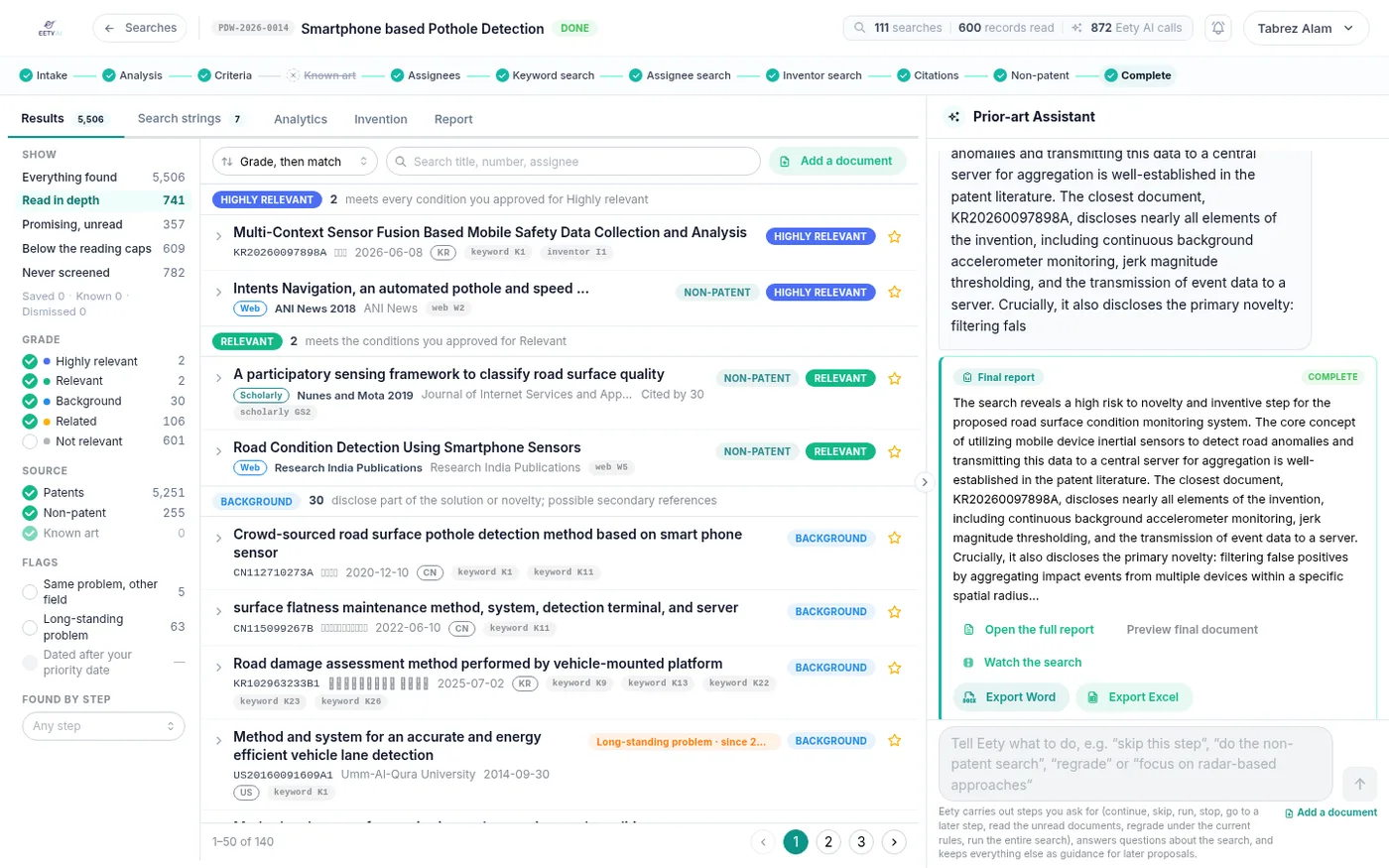
A finished search: 111 searches, 600 records read in depth, 5,506 documents found, graded against the criteria you approved. Export to Word or Excel.
You have worked with both. The careful one comes back with three questions before writing anything; the careless one hands you twenty polished pages built on facts nobody gave him. Eety drafts like the careful one. It refuses to write a word until it understands the invention at 90 percent confidence, and when something is missing it leaves a needs-input placeholder and asks your inventor, instead of inventing a fact to fill the hole.
Then it gets on with it. It drafts every section in parallel, generates the patent drawings under the drawing rules of the office you chose, and exports a filing-ready DOCX against templates for 5 patent offices: USPTO, EPO, PCT/WIPO, UKIPO and IPO India.
Generated patent drawings
33 figure types, planned from the claims, numbered and referenced the way an examiner expects.
Bring your own drawings
Already have figures? Upload them and Eety drafts the specification to match what you brought.
Drafted in your house style
The drafting library turns your granted patents into instructions, terminology, clauses and writing style, approved once for the whole organization and applied section by section.
$50
5 tokens, once per matter
5 offices
11 templates
90%
Understanding gate
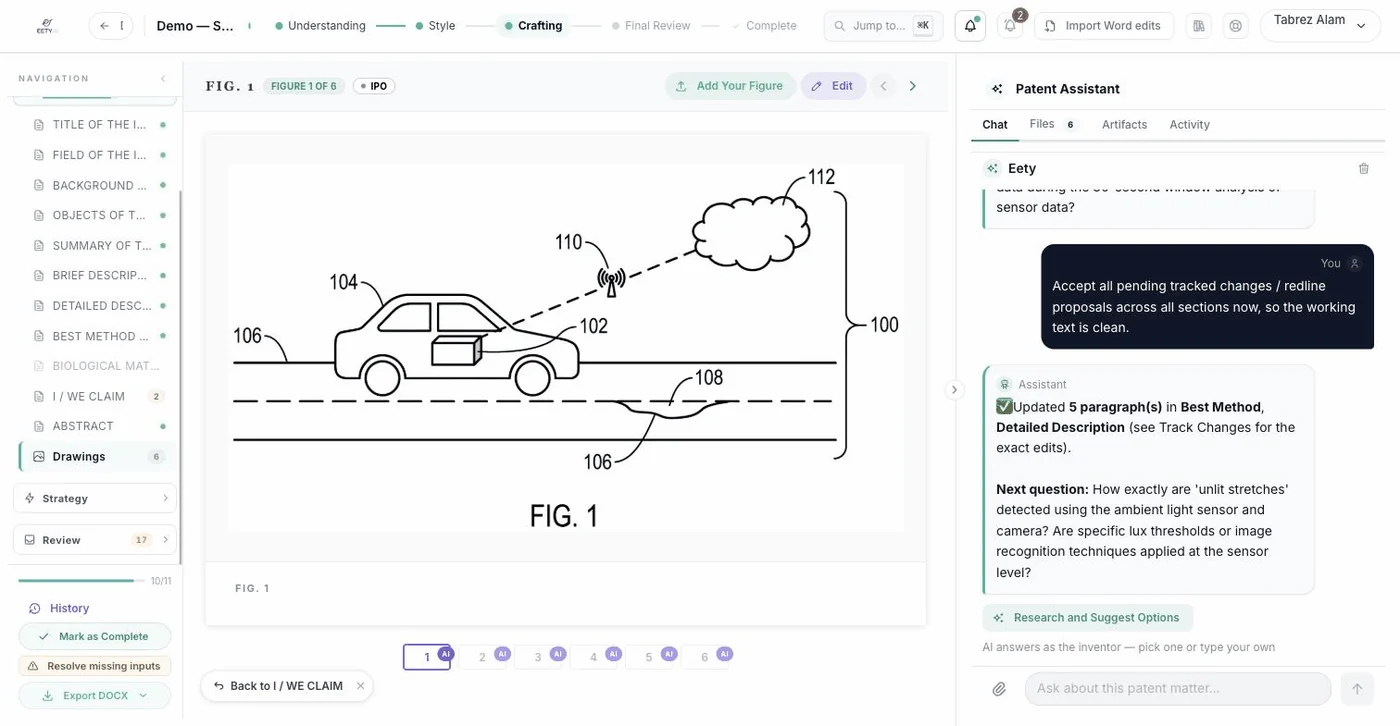
Drawings generated with the draft: FIG. 1, numbered to match the specification text.
When a draft comes back from your law firm, honestly, you either trust it or give up your own evening to check it... and most weeks there is no evening to give. Eety gives you a third option. Import the DOCX (headings match automatically, you can map sections by hand, and India Form 2 is detected on sight) and the full legal review reads the whole document at once. Your own drafts get the same review inside the matter.
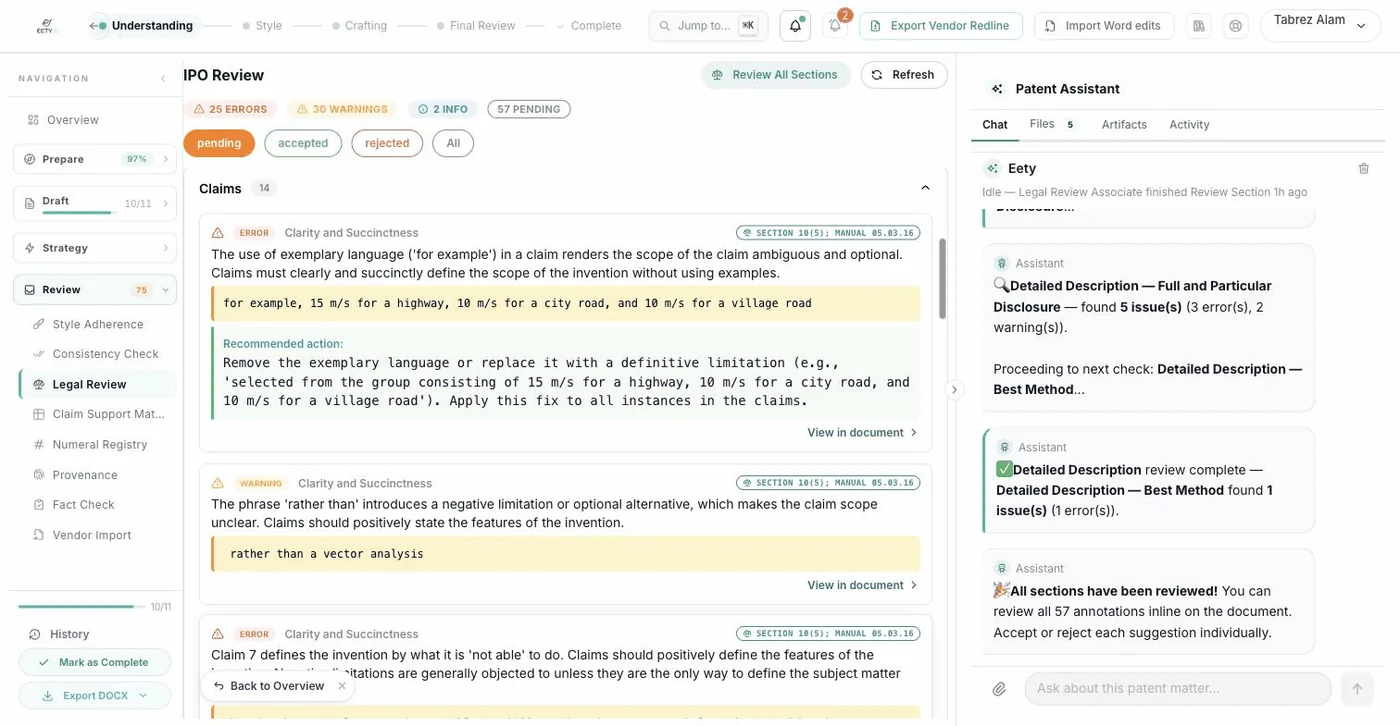
Findings come back per section as error, warning or info, each citing the authority it rests on, such as Indian Patents Act Section 10(5) or 35 U.S.C. 112(b). You accept or reject at the paragraph, then export a tracked-changes Word redline where every edit carries the name of who made it. So it goes back to the firm in Word, which is where they work anyway.
$30
3 tokens per counsel draft
Word redline
Real tracked changes
Authority cited
On every finding
A counsel draft after review: findings pinned to the paragraphs they concern, the authority cited beside each one.
Most of a company's patent work is written in someone else's building. Think of the front desk in a well-run office. A courier drops the parcel, signs the register and leaves; nobody hands him a key card. Eety keeps the record of the work the same way, without making the firm a user. You assign a search or a draft to a firm with a due date, and see what is out, what is overdue and what came back. When the report or the draft arrives, it lands on the invention's own record.
Then you act on it where it sits: run the review on the draft, add the report as prior art, or just attach it. Counsel keep working by email, as they always have, and the dashboard shows you the whole picture.
0 seats
For counsel
Overdue
Shown, not chased by email
Same record
End to end
Actually, let me back up a second. Four mechanisms carry the weight, and none of them is magic... each one is a rule the product refuses to break.
Eety measures how well it understands the invention, and it will not draft below 90 percent. Below the gate it goes back to your inventor with the missing questions, the way a good colleague would, instead of inventing answers.
Understanding threshold before a word is written
Prior art hides in two dialects (the way patents are written and the way papers are written), and it hides in different fields of a document. Every string Eety proposes says what it is looking for, why, and whether it searches titles and abstracts, the claims or the full text. You read the reasoning before you approve the round.
A review that arrives as a separate report means flipping between two documents. Here the findings sit on the draft itself, and you accept or reject each change at the paragraph it concerns, the way you would with a colleague's markup.
The exported redline is a real tracked-changes DOCX where every edit carries the name of who made it, and the organization keeps an audit trail of every action behind it. When someone asks who changed claim 3, there is an answer.
Some companies will not let an unfiled invention leave the building, and we understand why. For them, Eety runs on-premise: everything except the AI model and the search engines runs on your side. Think of a serious head of security. He never says nobody leaves the building; he shows you the log. So we say exactly what leaves, because "your data never leaves your network" would not be true of any AI product, ours included.
Eety Cloud
Sign up today, start on free tokens.
Hosted by eety on Google Cloud, with tenant keys on every customer table, a per-matter ledger and an audit log of every action. The right choice for individual practitioners, firms and companies that are fine with a well-run cloud.
Eety On-Premise
The application, the workers, the database and every file, inside your network.
Disclosures, drafts, search results, reports, the matter ledger and the audit trail live in your database and your file store. Document processing (OCR, Office conversion, Word, Excel and PDF generation) happens inside the deployment. Nothing is sent to eety.
What we do say
Runs on your infrastructure. Your documents, drafts, reports, search results and audit trail stay in your database and your file store. Nothing is sent to eety.
What we do not say
"Air-gapped", "your data never leaves your network", "private AI model", "SOC 2 certified". None of those is true today, so you will not find them on this page.
What you can ask for
A DPA, the sub-processor list, a completed security questionnaire, and the full "what leaves your network" sheet. Deployed to enterprise customers by eety engineers.
Drafting tools commonly claim 10 to 15 hours saved per application. That is their claim, not ours, and we are not going to invent an hour figure of our own to top it. :) What we can say precisely is what a company pays today, and what each step costs here.
What companies pay
$7,501 to $10,000
The most common budget band for one complete utility application, before government fees. 60 percent budget $10,000 or less, and 58 percent have the majority or all of their priority applications prepared by outside counsel.
Source: IPO 2024 Corporate IP Practice Survey, 75 corporate respondents.
What each step costs here
$20 · $50 · $50 · $30
A verdict on whether to proceed, a prior-art search, a complete draft with drawings, and a review of the draft your firm sent back. Each one is charged once per matter, on one balance, with a ledger of who spent what.
What the hours quote skips
The decision, and the check
Hours-saved claims start where the specification begins and stop where it ends. But the decision before it, and the review after it, are where a company's money actually goes.
This is the briefing we walk an IP head through: where the money actually goes, why a drafting tool is the wrong shape for a company, the five modules on one record, who sees what, what leaves your network, and what it costs. Use the arrows, or your keyboard... and if you would rather listen, there is a four-minute narrated cut. The PDF is right below too.
Think of a city transit card. You load it once, every ride is charged at a posted fare, and the statement shows each journey. Tokens work the same way. Each service is charged once per matter: harvesting 2 tokens ($20), state of the art 1 ($10), a prior-art search 5 ($50), a full draft 5 ($50), review of a counsel draft 3 ($30). An organization runs one pool with a ledger of who spent what on which matter, and there is no per-seat license. Individual accounts get 25 free tokens at signup, no credit card.
Starter
$250
25 tokens at $10 each
Enough for a handful of matters end to end.
Growth
$1,000
112 tokens at $9 each
The pack most working teams land on.
Scale
$5,000
667 tokens at $7.50 each
For a department running a steady docket.
On-premise
Talk to us
Deployed inside your network
A services agreement plus the same tokens, in your own Google Cloud project if you prefer.
Here is what we actually run. Tenant keys on every customer table, a per-matter ledger and an audit log of every action, and access by department and role. The model runs under Google Cloud terms, in a region where Gemini is available, and customer-managed keys are supported on Google Cloud Storage. No badges we have not earned; a DPA, the sub-processor list and a completed security questionnaire on request.
It started as a drafting tool, because drafting was the work I knew. Then the companies using it kept asking me the same questions: which of these ideas deserves money, who is handling it, what did the firm send back, and can we keep all of this in-house? Not one of those is a drafting question... and that told me something. The writing was never where most of the money went; the deciding and the checking were. So the tool became the whole flow, up to the filing, and prosecution is not on it yet. You keep the judgment; Eety does the labor, and writes down who did what.
More about the founder →Three things, and nothing else. The text, documents, images and audio of each AI step go to Google Gemini through Vertex AI, in a Google Cloud project you can own, under terms that exclude training on your data. Search strings and publication numbers go to patent and literature databases through SerpApi. And the literature steps of a prior-art search fetch public web pages directly. Everything else (the application, workers, database, files and audit trail) stays on your servers, and nothing is sent to eety.
No, and that is deliberate. Counsel are recorded on the invention's matter, not licensed as users. You assign a search or a draft to a firm with a due date, see what is overdue, and receive the report or draft onto the same record. They keep working by email, as they always have.
No. An inventor sees the inventions they created or are named on, plus the searches and reviews linked to them, read-only. A team lead sees the captured inventions of their own team. The IP team's areas stay closed to R&D roles altogether.
One token is $10, and each service is charged once per matter: harvesting 2, state of the art 1, prior-art search 5, a full draft 5, review of a counsel draft 3. The organization runs one pool, provisioned by its admin, with a ledger of who spent what on which matter. There is no per-seat license; redrafts and re-reviews on the same matter are free.
Not today, and you will not find a badge on this page pretending otherwise. We list the controls we actually run (tenant keys on every customer table, a per-matter ledger and audit log, department and role access, Google Cloud terms for the model), we answer security questionnaires on request, and the on-premise option exists for companies whose policy is "internally hosted only".
Week one gets your organization, departments and five granted patents into the library. Weeks two and three: ten disclosures, two searches and three counsel drafts. Week four is the read-out, with the ledger and the audit trail open. Individuals can start today on 25 free tokens. We keep trying to say all this more briefly... honestly, one of your own disclosures will say it better than this page can.