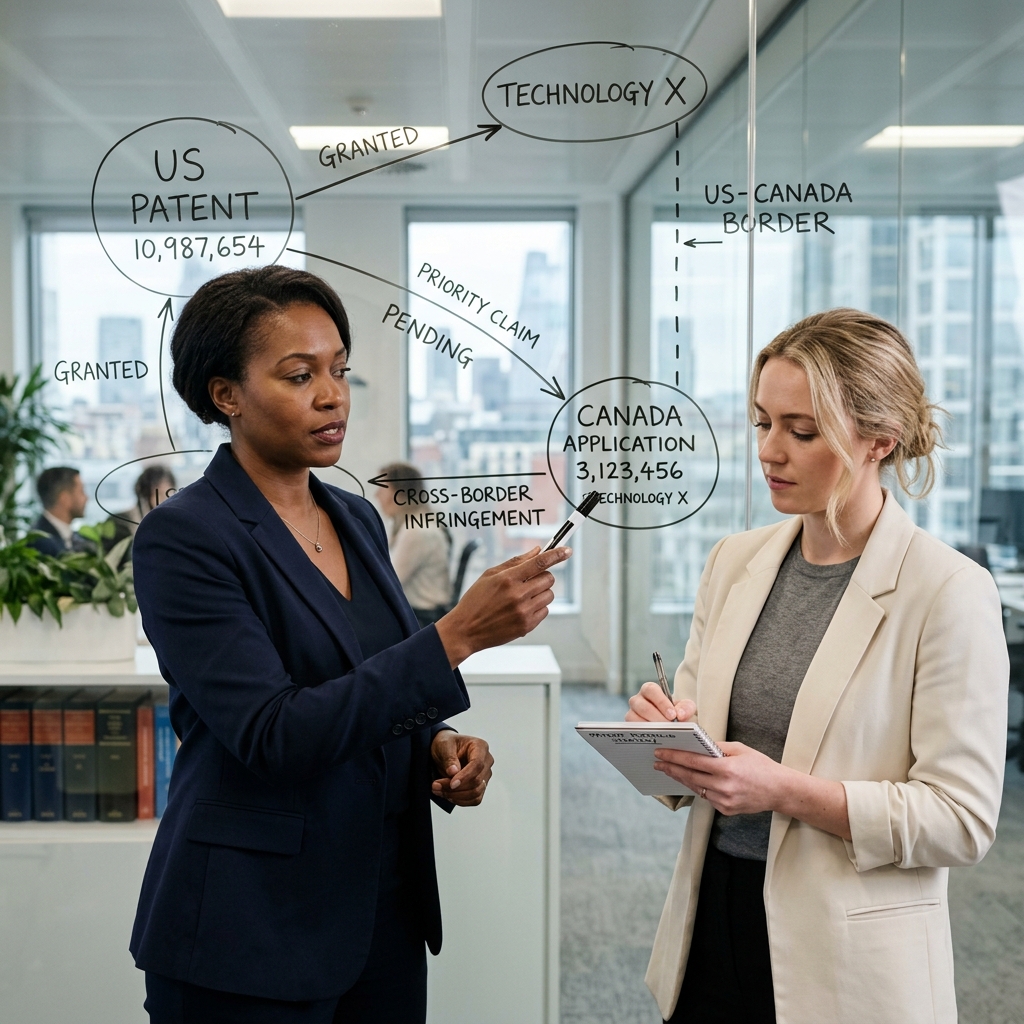
In 2006, Research In Motion paid $612.5 million to keep BlackBerry alive in the United States. They did not lose because NTP had better technology. They lost because NTP had better sentences. This is the story of those sentences; who wrote them, what they understood, and why no software in the world could have written them the same way.
Tabrez Alam
April 15, 2026 · Founder, eety.ai
Thomas Campana Jr. was an inventor. In the late 1980s, he built a system for transmitting messages wirelessly to handheld devices; long before "wireless email" was a phrase anyone used in a pitch deck. He filed patents. His attorneys prosecuted them carefully. And then, for years, nothing much happened.
Then Research In Motion built BlackBerry. And suddenly Campana's patents described, with uncomfortable precision, exactly how the BlackBerry system worked.
NTP, Inc.; the company that held Campana's patents after his death; sued RIM in 2001. The case went to trial. RIM lost. Then RIM appealed. The Federal Circuit issued its ruling in 2005; and the result was one of the most technically nuanced decisions in modern patent law: NTP won on some claims and lost on others. The split came down to two words. System. And Method.
Every BlackBerry in the US was routing through a server in Waterloo, Ontario.
Nobody at NTP planned for that. But they planned for something better.
RIM's defence rested on one fact: their BlackBerry Relay; the central server that routed all email to all devices; was physically located in Waterloo, Ontario. Not in the United States. Under 35 U.S.C. § 271(a), which governs patent infringement, the infringing act must occur within US territory. If a critical component of the alleged system sits in Canada, RIM's lawyers argued, you cannot have complete infringement under a US patent.
It was a clever argument. It was also not clever enough. Because NTP's attorneys had, years earlier and without knowing exactly this scenario would arise, written two different kinds of claims. And only one kind of claim was vulnerable to RIM's geography argument.
The settlement paid by Research In Motion in 2006.
At the time, the largest patent settlement in the history of technology.
Paid because of patent claims written twelve years earlier, for a world that did not yet exist.
NTP's patent portfolio included US Patent No. 5,436,960, among others. The attorneys had prosecuted both system claims and method claims. This is standard practice; good attorneys draft redundancy into a portfolio precisely because they do not know which claim type will survive which challenge. The genius in this case is that the redundancy did its job in a way nobody specifically planned for.
"An electronic mail system... comprising:
an originating processor;
a gateway switch;
and an interface switch...
disposed between the gateway switch and the RF wireless network..."
A system claim describes what exists; not where it exists. The court applied the "Control and Beneficial Use" test: where is this system controlled? Where is its benefit received? The user in New York hits send. The email arrives in Washington D.C. The beneficial use occurs in the US; regardless of which server in which country routed it on the way. System claims: infringed.
"A method for transmitting an email... comprising the steps of:
receiving the email at a gateway switch;
transmitting the email to an interface switch;
and forwarding the email to a wireless network..."
A method claim describes what happens; a sequence of steps. Under US law, for a method to be infringed in the US, every single step must be performed within US borders. The step "transmitting to an interface switch" ended at the Relay in Waterloo, Ontario. One step; one border; no infringement. Method claims: not infringed.
Here is what I find genuinely remarkable about NTP's attorneys. They were drafting in the early 1990s. The cloud did not exist. Distributed server architecture was not a consumer technology concept. "Routing through a foreign relay" was not a threat that any reasonable patent drafter at the time was designing around.
And yet they drafted system claims. They drafted method claims. They drafted apparatus claims. Not because they anticipated exactly this scenario; but because professional discipline says: you do not know which challenge your claims will face, so you build redundancy into your coverage. You defend from multiple angles not because you can predict the specific attack; but because you know attacks come from directions you did not plan for.
That discipline is twelve years of professional training. It is the institutional memory of the profession. It is the kind of judgment that says "I have seen claims fall in unexpected ways; let me draft something that does not fall the same way." No one articulates that out loud. It just shapes how the document is written.
NTP's attorneys did not define the "Interface Switch" by its physical hardware. They defined it by its function. This forced RIM to argue: "our Relay is not the interface switch." But in arguing that, RIM had to describe what the Relay did; which was exactly what the interface switch did. The trap closed from the inside.
I want to be honest: it is very easy in 2026 to look at 1992 patent claims and say "they should have done it differently." That is hindsight with a thirty-year advantage. The attorneys who drafted those claims were excellent at their craft. The geographic vulnerability in the method claims was not negligence; it was blindness to a future that nobody in 1992 had any reason to anticipate.
But the lesson they taught the world is now the standard for every patent attorney drafting claims for distributed architectures, cloud systems, AI platforms, and anything that might route through a server in a different country. Here is what the method claims could have done:
"Transmitting the email from a domestic gateway to a remote interface..."
The act of "transmitting from" happens entirely within US territory; regardless of where the transmission ends. The relay being in Canada becomes irrelevant because the infringing step is the departure, not the arrival.
"Displaying the transmitted email on a destination processor located within a wireless network."
If the last step of the method is the "display" on the handheld device in the hands of a user in New York, the method concludes in the US. Every step before it becomes geography that does not matter.
"Initiating a transmission command from a handheld device to a remote server to trigger email redirection."
By making the "initiation" the patented step, you move the legal site of the infringement to the person holding the BlackBerry in Washington D.C.; not the server in Ontario. The infringing actor becomes the user; and the user is indisputably in the US.
I want to make a precise claim here. If you had given an AI tool in 1992 the technical details of Campana's wireless email system and asked it to draft patent claims, it would have produced good claims. Technically sound, properly formatted, covering the invention as described. It would have included method claims describing the steps of the process in the most natural, logical order: receive; transmit; forward; deliver.
And it would have written exactly the method claims that failed in 2005.
Not because the AI was poorly designed. Because the AI had no way of knowing that one day, a company called Research In Motion would route those transmissions through a server in a country that fell outside 35 U.S.C. § 271(a)'s territorial scope. In 1992, nobody could know that. The AI would have drafted for the technology as understood; not for the legal landscape that technology would eventually inhabit.
The reason NTP's system claims survived is not that the attorneys used better software. It is that they understood, through professional formation and practice, that you do not just describe what the invention does; you describe what it is, so that the court can apply "beneficial use" tests that travel with the users, not with the servers. That understanding lives in the attorney's head. It is built from years of prosecution and litigation and reading decisions and watching what breaks and what holds.
It is, in other words, exactly the kind of judgment we talked about in this series. Not drafting speed. Not claim formatting. Not the mechanical work that AI tools like eety.ai genuinely handle well. It is the forward-looking territorial strategy that separates a patent that holds for thirty years from one that fails on a single procedural geography argument and costs your client exactly nothing in settlement.
If the NTP story makes you want to understand the broader principle; why granted patents are more fragile than they look, and what it takes for a claim to survive not just prosecution but also the full adversarial pressure of litigation; I wrote about that principle directly in Getting a Patent and Having a Useful Patent Are Two Different Things. The NTP case is one illustration of many. The article gives you the framework for thinking about all of them.
I wrote recently about an inventor at a startup event who had decided not to file her patent because the attorney's quote was more than her monthly salary. She concluded that expert patent help was not reachable on her budget. I wrote that one of the things AI tools do is make that help more accessible; by reducing the mechanical hours in drafting, lowering the cost, and opening the market to inventors who were previously priced out.
All of that is still true. I believe it.
But the NTP v. RIM case is the precise illustration of what happens when the expert is not in the room at all. NTP's attorneys were not cheap. Thomas Campana was not a large corporation with a hundred-person IP department. But he invested in professional patent prosecution; in attorneys who drafted for redundancy, who defined elements by function rather than hardware, who built a portfolio of claim types precisely because they knew that not all claims survive all challenges.
That investment returned $612.5 million to his estate. Not because the attorneys were fast. Not because they used the most powerful drafting software. Because they were good. Specifically, terrifyingly, jurisdictionally good.
AI tools should handle the mechanical work. So that the attorneys who are "specifically, terrifyingly, jurisdictionally good" can spend their time being exactly that.
The inventor who previously could not afford the expert now can; because AI has reduced the cost of the mechanical parts. The expert is still in the room. Just with more time to think. :(
P.S. RIM settled for $612.5 million to avoid a US injunction that would have shut down every BlackBerry device in the country. The settlement was announced on a Friday afternoon. By Monday morning, there had been no shutdown; every BlackBerry was still syncing. Most users never knew it was almost over. The attorneys who saved it were not in any press release. That is usually how it works. :(
NTP's attorneys saved the case with system claims because their time was spent on strategy, not typing. eety.ai drafts the mechanical layers; so yours can too.
The competitive timing argument for AI adoption.
For IndividualsWhat AI takes and what it categorically cannot replace.
Case Study · Apple v. SamsungSlide to Unlock, the ghost from Sweden, and why patenting the look of your interface is a losing strategy compared to patenting the engine behind it.