Case Study Patent Strategy Apple v. Samsung · 2012–2016 ⏱ 9 min read

Patent the engine,
not the button.

In 2004, a small Swedish company shipped a phone that required users to swipe right to unlock it. Nobody wrote about it. Nobody filed a lawsuit. Three years later, Apple filed US Patent 7,657,849 and suddenly that Swedish phone became the most important piece of prior art in the biggest patent war in consumer electronics history.

TA

Tabrez Alam

April 15, 2026 · Founder, eety.ai

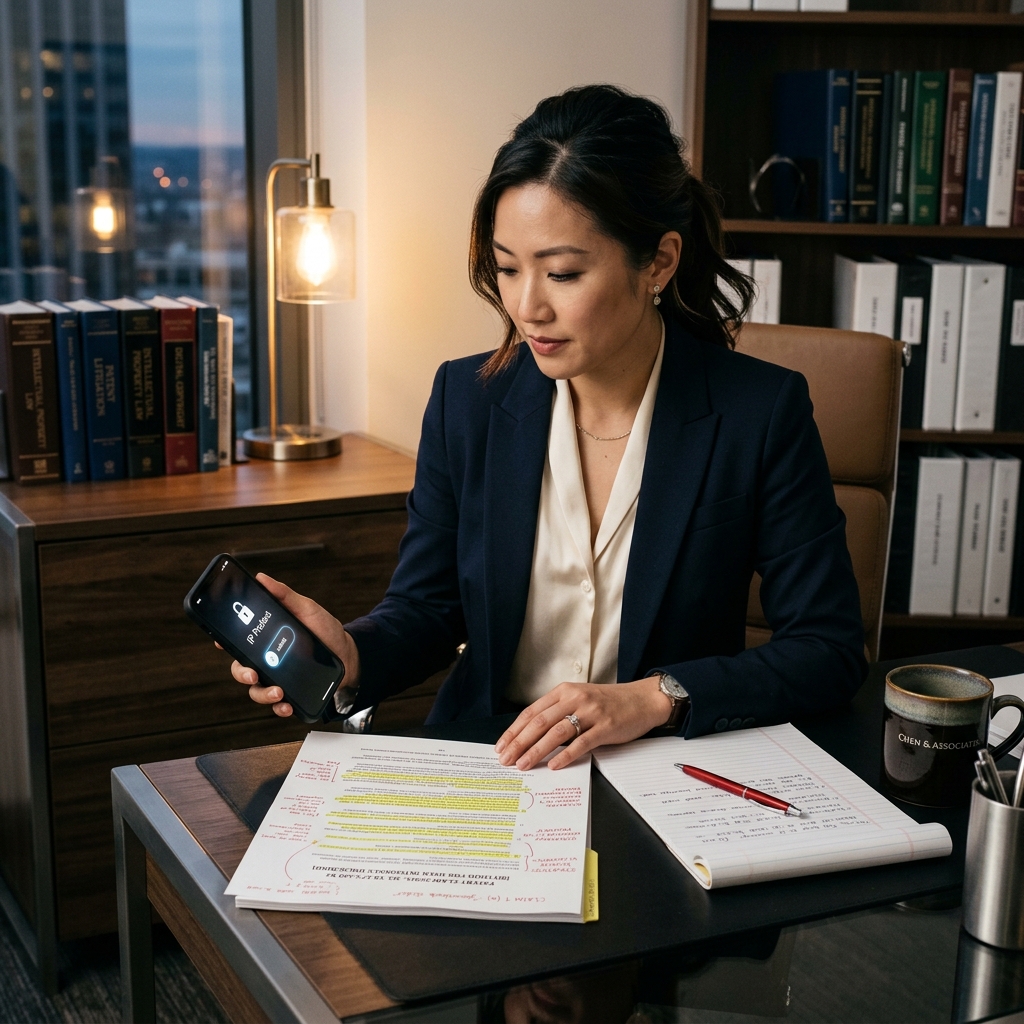
A female IP attorney studying the Apple Slide to Unlock patent claim language alongside her phone; the intersection of tech and legal strategy
Act I: The moment

January 9, 2007. Somewhere in Sweden, an engineer watches the keynote.

Steve Jobs slides his finger across the screen. The audience laughs; there is something almost playful about it. A lock icon follows his thumb across a glowing track, reaches the end, and the phone unlocks. He does it again. The crowd applauds something that, in retrospect, feels inevitable and obvious.

In Gothenburg, Sweden, an engineer named Magnus Goertz had shipped a phone called the Neonode N1m in 2004, three years earlier. It had a small screen. It was not a beautiful device. And it unlocked when you swiped your finger from left to right across the screen.

He watched the keynote. He thought something. History does not record exactly what; but by 2012, when Apple sued Samsung for patent infringement, what he thought became the centrepiece of one of the most expensive patent disputes in the history of consumer technology.

This is a different kind of patent story from the one we told about NTP and BlackBerry. That case was about geography: where does the infringing act happen? This case is about obviousness: is this invention genuinely new; or is it just the obvious next step that anyone paying attention would have taken?

Both questions are ultimately about the same thing: the quality and specificity of the claim language. And both answers, in very different ways, show you exactly why expert patent attorneys are not optional for anyone building something worth protecting.

Act II: The claim

US Patent 7,657,849. What Apple actually patented; and why it was smarter than it looks.

The first instinct when you hear "slide to unlock" is to assume Apple tried to patent a gesture; that they walked into the USPTO and said "we want to own the swipe." They did not. If they had tried that, the examiner would have rejected it in the first office action and the attorneys would have gone back to the drawing board.

What Apple's attorneys actually claimed was a specific sequence of system events, each visually and technically distinct from anything that existed in the prior art at the time of filing. Here is the core claim language, simplified:

"A method of unlocking a hand-held electronic device, the method comprising: at a device with a touch-sensitive display: detecting contact with the touch-sensitive display at a predefined location; moving an unlock image along a predefined path on the display in accordance with the detected contact; and unlocking the hand-held electronic device if the unlock image reaches a predefined end of the predefined path."

Three moves, each carefully chosen. First: contact at a predefined location (not anywhere on the screen; specifically at the start of the slider track). Second: an image that moves in accordance with the contact (not just a trigger; a visual feedback loop tied to the finger's position in real time). Third: an unlock that only occurs if the image reaches the end of the path (a conditional state change, not just a gesture completion).

This is not a swipe. This is a state machine described in legal language. And that distinction is either the most brilliant thing about the patent; or the most fragile thing. Depending on where you are standing when the Neonode arrives in evidence.

1
The Unlock Image requirement

Older touchscreens unlocked on a swipe. The Neonode unlocked on a swipe. But neither required a visual element that followed the user's finger in real time and only triggered unlock upon reaching a destination. This is what Apple argued made them different. The image was the moat.

2
The Predefined Path requirement

Random swipes in any direction would not trigger unlock. The claim required a specific track. Apple called this a safety feature: a phone in your pocket generates accidental touches constantly; the predefined path prevents those touches from unlocking the device. Clever. The claim married function to the visual metaphor.

3
The Conditional State Change

The device does not unlock on gesture completion. It unlocks if the image reaches the end. This if-then logic transforms a UI gesture into a system processing method. On paper, this should have been robust. Until Samsung's lawyers flew to Gothenburg.

Act III: The ghost

Samsung's lawyers
flew to Gothenburg.

The Neonode N1m was not a successful product. It sold modestly in Sweden and some surrounding markets in 2004, had a tiny screen, and was quickly forgotten when Nokia and Motorola dominated the mid-2000s handset market. Nobody had reason to notice it.

By 2012, Samsung's patent litigation team had every reason to notice it. They found it. They brought it into evidence. They played the product's own promotional video in court: a user swipes right; the phone unlocks. No moving image that follows the finger. No predefined path with a visual slider. Just: right swipe; phone unlocks.

Apple's response was sharp. "Our patent requires the moving image. The Neonode does not have a moving image. That is the distinction." And technically, they were right. The Neonode did not have the unlock image sliding in real time with the user's finger.

The courts in Europe saw it differently. Courts in the Netherlands and Germany ruled that adding a "moving image" to an existing swipe unlock mechanism was obvious. In patent law, "obvious" is a term of art: it means that an engineer with ordinary skill in the field, given the existing prior art, would have arrived at the same addition without inventive effort. If that is true, the patent is invalid regardless of how specific the claim language is.
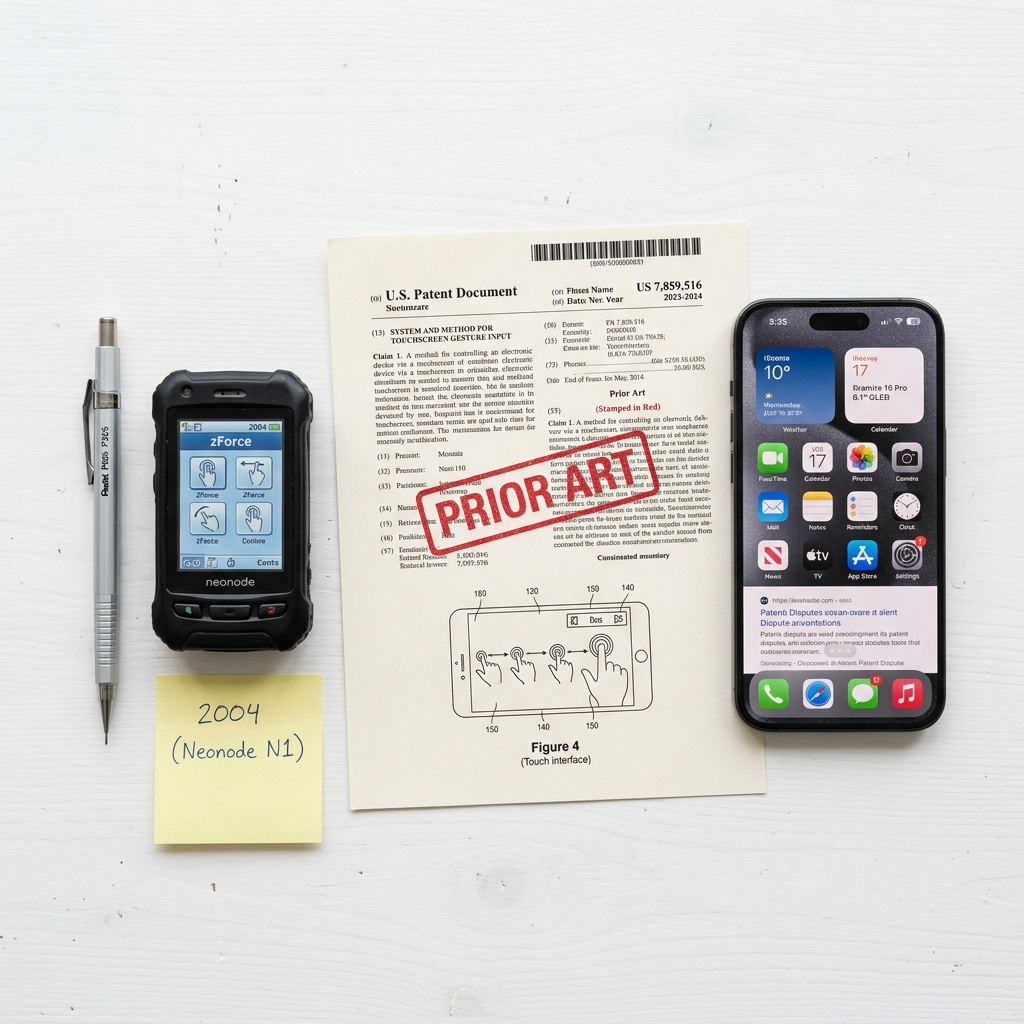
The Neonode N1m (2004) next to a modern smartphone; the prior art that challenged Apple's most famous patent

The Neonode N1m. Released 2004. Completely forgotten.
Until Samsung's lawyers went to Sweden. Then remembered quite urgently.

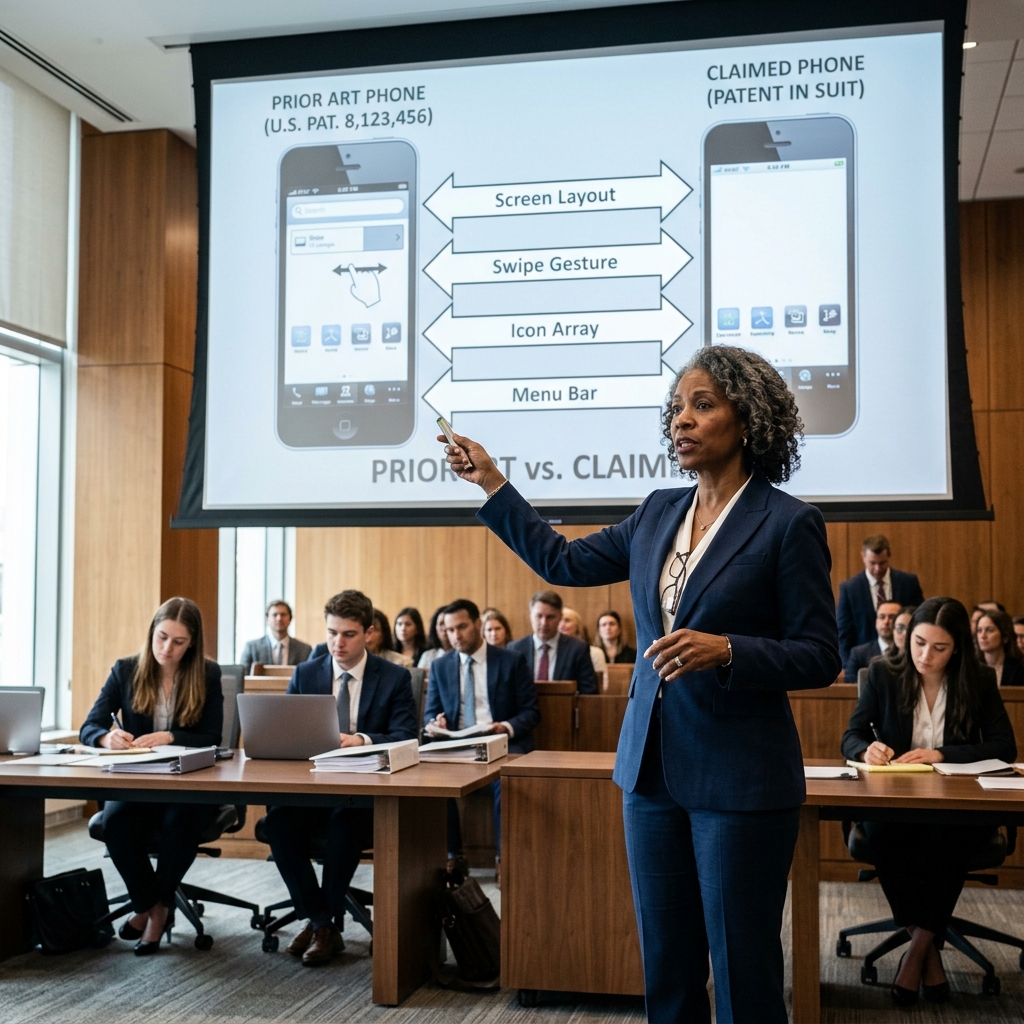
A senior patent attorney presenting prior art vs claim comparison in a modern courtroom; the kind of expert argument that decided the Apple Samsung case
Act IV: The verdict(s)

The case that went to verdict;
then appeal; then en banc;
then everyone moved to Face ID.

The US litigation ran a different course to the European cases. In the original Apple v. Samsung jury trial in 2012, Apple won. Samsung was found to have infringed several patents including Slide to Unlock, and a jury awarded over a billion dollars in damages; later reduced significantly on appeal.

In 2016, the Federal Circuit actually invalidated Apple's Slide to Unlock patent; a remarkable reversal. The court essentially ruled that the jury had been wrong to find the patent valid against the Neonode prior art. But then, in an unusual en banc review; meaning the full Federal Circuit court reconsidered the panel's decision; the invalidation was reversed on a procedural point, and Apple ultimately collected approximately $119 million in damages from Samsung.

By the time any of this resolved, both companies had moved on. Apple had replaced Slide to Unlock with Touch ID in 2013 and Face ID in 2017. Samsung had its own biometric systems. The gesture that started the war was already a museum piece before the war formally ended.

Jurisdiction Outcome on Slide to Unlock Reason
🇺🇸 US (jury, 2012) Valid / Infringed Jury found Neonode distinction sufficient; moving image was non-obvious addition
🇳🇱 Netherlands (2012) Invalid Dutch court ruled adding a visual slider to swipe unlock was "obvious"; Neonode was sufficient prior art
🇩🇪 Germany (2013) Invalid German Federal Patent Court similarly found the moving image element was an obvious UI addition
🇺🇸 US Federal Circuit (2016) Invalid (panel) Panel reversed jury on obviousness; Neonode combined with knowledge of visual feedback made the claim obvious
🇺🇸 US Federal Circuit en banc (2016) Damages preserved Full court reversed panel on procedural grounds; Apple collected ~$119M but the underlying validity remained contested
Act V: The drafting lesson

What the claims could have said. And why this matters for every AI founder building today.

Apple's attorneys were not negligent. The Neonode was genuinely obscure prior art in 2007, and the claim language they chose was the right language for the technology in front of them. But in hindsight; which is the only place patent strategy lessons come from; here is where the vulnerability was, and what stronger language would have looked like.

The fundamental problem was that the claims were anchored to a visual metaphor (the sliding image) rather than to the underlying processing logic. UI elements get called "obvious." Processing logic does not. Here is how the rewrite goes:

Strategy A: Patent the state machine, not the image
"detecting a velocity and direction vector of the contact; maintaining a locked device state unless the velocity exceeds a threshold value within the predefined path direction..."

Velocity thresholds are not UI. Velocity thresholds are processing logic. An examiner, and crucially a court, would have much more difficulty calling this "obvious." The Neonode had no velocity checking. A plain swipe has no velocity checking. This would have separated Apple's invention from every predecessor on a technical axis, not a visual one.

Strategy B: Haptic and visual synchronisation as the claim
"providing haptic feedback synchronised to a position of the contact along the predefined path, wherein the haptic feedback intensity varies proportionally with progress toward the unlock state..."

The Neonode had no haptic system. Claiming the synchronisation of visual feedback and haptic feedback to the same positional variable would have made the "obviousness" argument nearly impossible to run. You can argue that adding a visual slider to a swipe is obvious. It is much harder to argue that synchronising two separate output modalities to a real-time positional input was obvious in 2007.

Strategy C: Patent the intent detection, not the gesture
"ignoring all touch events not originating within a predefined initiation zone; and processing only those touch events whose origin coordinate falls within said zone as potential unlock inputs..."

This transforms a "UI feature" into a "security processing method." The device actively discriminates between touch inputs based on origin coordinate; this is touch input filtering, a processing behaviour; not a visual design. Processing methods are consistently harder to invalidate as obvious because they have a technical function (preventing accidental unlocks) that must be specifically implemented in code.

The look of your interface is what users see. The engine of your interface is what survives a patent challenge. Every claim that describes how something appears is an invitation to find prior art. Every claim that describes how something processes requires a court to prove that a different system processed it the same way.
Two cases. One lesson. Different vulnerabilities.

NTP vs. Apple: what each case got right and what each got wrong

I wrote last week about NTP v. RIM and how the attorneys there saved NTP's case with system claims when the method claims failed on geographic grounds. This case is a different failure mode; and a different save. But the underlying lesson is the same: the claims that survive are the ones written with the most precise understanding of how your technology will be challenged. Not just examined; challenged. Years later, in a courtroom, by people whose only job is to find the way through.

Dimension NTP v. RIM (2005) Apple v. Samsung (2012–2016)
Core vulnerability Geographic: method steps split across US and Canada Obviousness: UI visual element deemed ordinary addition to prior art
What saved them System claims (drafted by discipline, not foresight) Procedural en banc reversal (not a substantive patent win)
What the attorneys got right Multiple claim types; functional definition of components State-machine language; conditional unlock logic; predefined path
What the attorneys missed Territorial anchoring: method steps exposed to foreign server locations Avoided visual metaphors: anchoring to processing logic rather than UI appearance
The lesson Draft for where the technology will live; not where it lives now Patent the technical engine; not the user-visible output
Final outcome $612.5M settlement; BlackBerry stayed alive ~$119M damages; but Slide to Unlock itself was already gone
The close: for everyone building software right now

What eety.ai should patent. What you should patent. And why those are probably the same thing.

I think about both of these cases frequently when I think about eety.ai's own IP strategy. We have a conversational interface. We have a confidence score displayed to the user. We have a progress bar and a visual indicator that tells the attorney "you are at 87%; here is what is missing." All of that is visible. All of that is design. All of that would fail an obviousness challenge the moment someone found a prior art system that did anything similar.

The things worth protecting are the things you cannot see. The brain extract: how the system derives structured invention understanding from an unstructured disclosure conversation. The confidence calculation: the algorithm that weights answered versus unanswered questions, marks some questions as critical versus supplementary, and decides when the understanding is sufficient to begin drafting without guessing. The gap detection: the logic that identifies which elements of a typical claim structure are unsupported by the inventor's responses; and which questions to ask next to fill those gaps.

These are the engine. Not the button. Not the slider. Not the confidence percentage that appears on screen. The processing logic that generates that percentage; and specifically how it is calculated; is what would survive a prior art challenge ten years from now when some other company has built a similar-looking interface and is arguing in court that the "look" was obvious.

Patent what no one can see. Protect the logic, the calculation, the conditional; not the colour of the slider or the phrasing of the progress bar. The look gets replaced by the next design trend. The engine runs for twenty years.

Apple built something genuinely beautiful in 2007. But beauty is not prior art immunity; and it is definitely not an en banc reversal. :)

P.S. The Neonode was a remarkable little device for its time. It ran a custom version of Windows CE, had a resistive touchscreen, and retailed for about 300 Euros in 2004. Magnus Goertz and his team built something genuinely clever long before anyone was paying attention. The lesson is not that they deserved the credit Apple received. The lesson is that in patent law, being first is less important than being specific. And being specific requires expertise. :(

For software founders building something worth protecting

Start with the engine.
Not the interface.

eety.ai helps patent attorneys draft precisely and deeply; so the claims that matter get the specificity they need. Start with a disclosure. See what the system asks; and what it finds.

The Patent Strategy Series