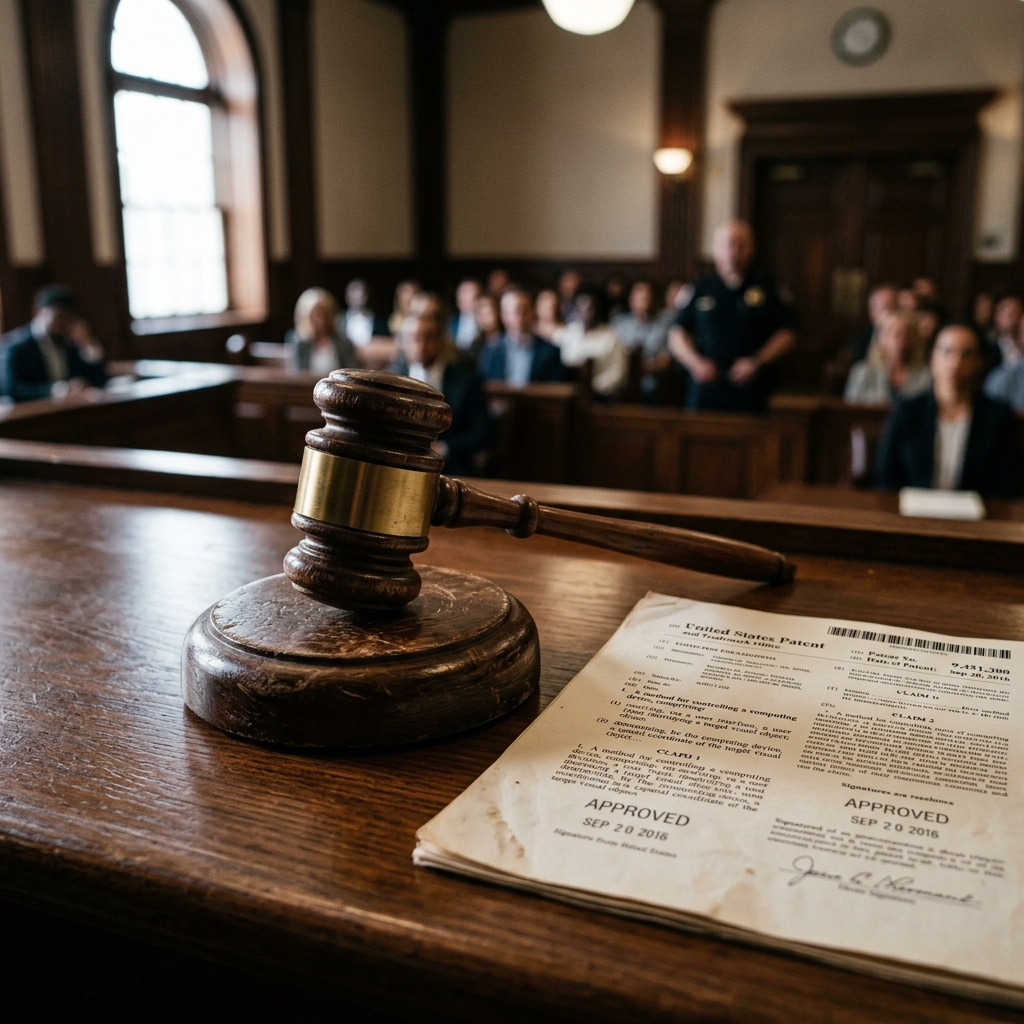
A patent grant is a beginning, not an ending.
Most inventors treat the Notice of Allowance as the finish line. Three or four years of prosecution, office actions, arguments, amendments, and finally: granted. The certificate arrives. The patent number is assigned. The celebration happens.
And then, eventually, someone challenges it. Or you try to enforce it. And the question of whether the patent is actually valid gets answered by someone who was not in the room when you were arguing with the examiner.
The gap between a granted patent and a useful patent is real. It is well-documented. It trips up sophisticated inventors and well-funded companies. And it almost always traces back to decisions made during prosecution that seemed reasonable at the time.
The journey from filing to enforcement
It helps to think about this as a sequence of distinct stages, each with its own standards and its own risks.
Filing
You claim what you believe is novel. The specification supports those claims. You pay the fees. The application is pending.
Prosecution
The examiner searches the prior art, issues rejections, and you respond. This process involves argument and amendment. Amendments narrow claims. Arguments get recorded in the prosecution history.
Grant
The examiner allows the claims. The patent issues. Legally, it is presumed valid. That presumption matters, and it is not trivial. But it is rebuttable.
Challenge
An IPR is filed at the PTAB, or a defendant challenges validity in district court litigation. Now your claims are evaluated by a different decision-maker, under different standards, with a different prior art record.
The examiner and the PTAB both look at validity. But they do it differently. The examiner works with prior art that was of record during prosecution. The PTAB works with whatever the petitioner found, often with considerably more resources and incentive to find it. And courts apply claim construction through a different lens than the examiner did.
What makes a claim survive
A claim that survives prosecution is a claim the examiner found distinquishable over the prior art of record. A claim that survives litigation is a claim that holds up to the full weight of interpretation, construction, and validity challenge from an adversary who is motivated and funded.
The claims that survive both of those tests are claims that were drafted with the end in mind, not just the allowance.
What does that look like in practice?
Prosecution history estoppel
Every amendment you make during prosecution to distinguish prior art creates a record. That record follows the claim forever. When you narrow a claim to get it past the examiner, you give up the right to assert that the claim covers things you narrowed it away from. The doctrine of equivalents, which allows some flexibility in what a claim covers beyond its literal language, is limited by what you argued and amended during prosecution.
A claim that survived prosecution by making very specific distinctions may have no room left to operate in litigation. The literal scope is narrow. The file history forecloses equivalents. The competitor drives a truck through the gap.
The NTP v. RIM case; where Research In Motion ultimately paid $612.5 million; is perhaps the clearest modern illustration of this gap. NTP's method claims survived prosecution perfectly well. They failed in litigation for a reason nobody in the prosecution room had anticipated: one step of the method was performed by a server in a different country. The case is worth reading in detail because it shows, concretely, what "drafting with the end in mind" means. The Relay Was in Canada covers the claims, the court's reasoning, and what the attorneys could have done differently.
Written description and enablement
A claim is only as valid as its specification support. If you claim something that the specification does not adequately describe or enable, the claim is vulnerable. This comes up most often when claims are broad and the specification is thin, or when the claims were amended during prosecution to cover something the inventor had not fully worked out.
The examiner may allow the claim. Under the standard for rejection during prosecution, the examiner has to have a reasonable basis to reject. Without clear evidence of a written description or enablement problem, the examiner may give the benefit of the doubt. A petitioner challenging validity at the PTAB does not need that benefit of the doubt. They have to show the claim is unpatentable by a preponderance of the evidence. That is a lower threshold than the examiner's standard, and challengers know it.
Claim construction
Words in claims mean things. Specifically, they mean what a person of ordinary skill in the art would understand them to mean, in light of the specification and the prosecution history. Courts interpret claim language. Parties disagree about what terms mean. Claim construction rulings can make a patent nearly worthless or extend it considerably.
If the NTP case showed what can go wrong with the geography of a method claim, the Apple v. Samsung slide-to-unlock saga showed a completely different vulnerability: anchoring claims to a visual interface element instead of the underlying processing logic. Both patents survived examination; both faced unexpected challenges in litigation. Patent the Engine, Not the Button covers what Apple's attorneys did right, what they left exposed, and the lesson that is now taught in every serious patent prosecution course.
This is not an academic exercise. Markman hearings routinely determine the outcome of patent cases before a single fact witness testifies. A claim that seemed clear when drafted can become the subject of years of expensive litigation over what a single word means.
The statistics are sobering
These numbers vary by technology area and over time. But the underlying point does not vary: a granted patent is not a finish line. It is the beginning of a period where the patent either holds up or it does not.
What this means for how you draft
The implications for claim drafting are significant. Claims need to be broad enough to cover what matters commercially, narrow enough to get past the prior art, and drafted with language that will hold up to adverse construction in litigation.
That is a hard set of constraints to satisfy simultaneously. It is why claim strategy matters. It is why the specification has to do real work, not just support the claims enough to get them through prosecution, but support them in a way that makes them defensible later.
It is also why the first draft of a patent application is not just a technical document. It is a legal instrument that will be read by adversaries who are looking for weaknesses. Every vague term, every overclaimed element, every gap in written description support is a place where the patent becomes vulnerable.
A granted patent is a real asset. It provides presumptive validity, licensing leverage, and a deterrent to copying. But the value of that asset depends almost entirely on the quality of what was drafted before the examiner saw it.
The grant is not the measurement of quality. What survives after the grant is.