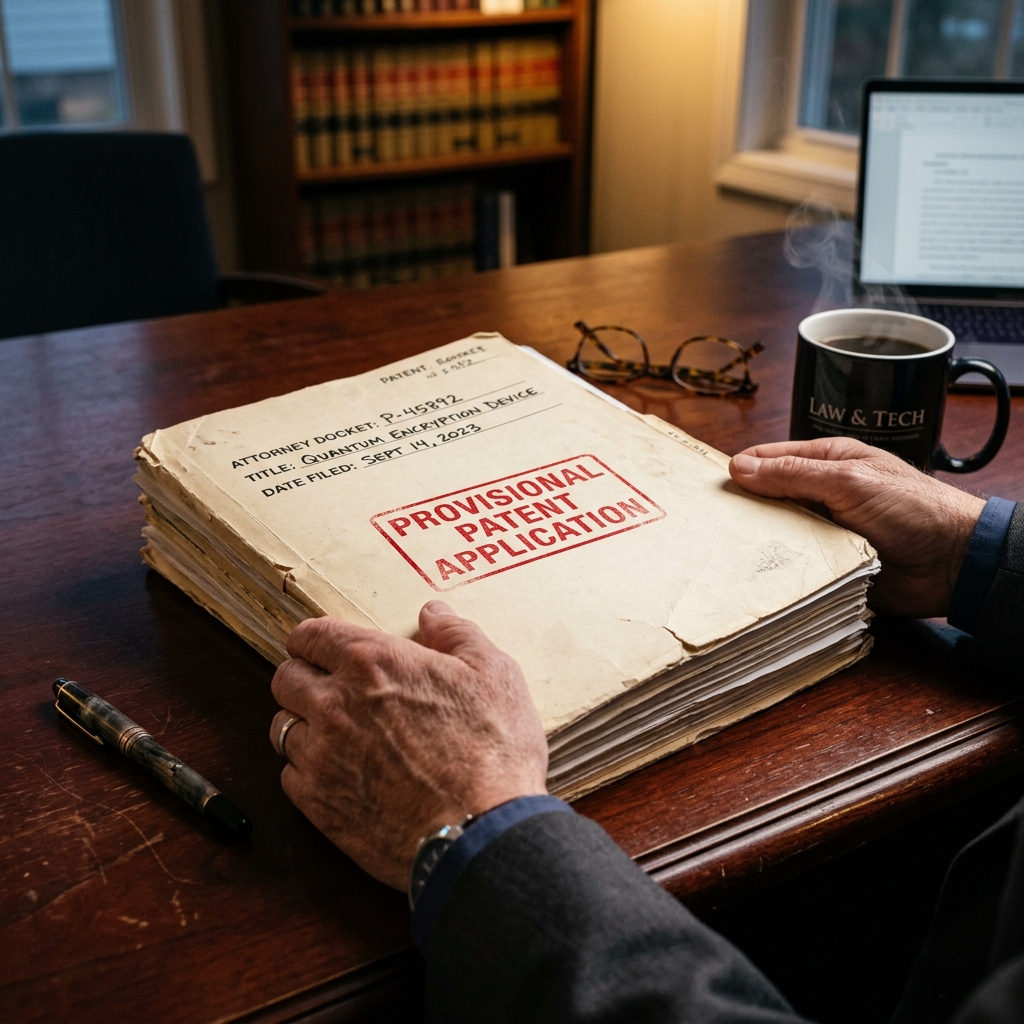
Most inventors hear "provisional patent" and think: placeholder. File something rough. Lock in your date. Come back in a year with the real thing.
That is not entirely wrong. A provisional does give you twelve months. It does establish your priority date. And yes, it carries "patent pending" status, which matters for a lot of reasons.
But there is a part of the story that does not come up enough. A poorly written provisional does not just fail to help you. It can actively work against you.
A provisional patent application becomes prior art. If your non-provisional discloses something that was not in the provisional, you cannot claim priority to that earlier date for those elements. And if a competitor cites your own provisional against your later claims, you have a serious problem.
What a provisional actually is
A provisional patent application is a legal document filed with the USPTO. It is never examined. It never becomes a patent on its own. It expires in twelve months automatically, unless you file a corresponding non-provisional application that claims priority to it.
What it gives you is a date. The date you filed the provisional becomes your priority date for the subject matter you disclosed in it. If someone files a competing application after your provisional date but before your non-provisional, your priority date protects you, as long as your provisional actually disclosed the relevant subject matter.
That last part is where things get complicated.
The three ways a provisional goes wrong
1. It discloses the concept but not how it works
A provisional that says "a system for detecting anomalies in sensor data using machine learning" discloses almost nothing. It does not teach the method. It does not describe the architecture. It does not explain the claim-worthy elements.
When the non-provisional is filed twelve months later with all the technical detail, those details cannot claim priority to the provisional date. If someone filed a competing application in the interim, your priority date does not protect the things you did not write down.
2. It is filed with a draft claims set the attorney barely read
Some attorneys treat the provisional as an administrative exercise. Draft a set of rough claims, attach a few pages of description, file it within budget. The provisional gets the date. The real work happens later.
The problem is that claims define what you protect. If the claim strategy changes significantly between the provisional and non-provisional, and the non-provisional cannot find support in the provisional for the new claims, you have lost the priority date for those claims. You filed a year ago and you are starting over.
3. It becomes prior art against you
This is the one that surprises people most. Your own provisional can become statutory prior art under 35 U.S.C. 102 if it was published or publicly available, or if it is used to demonstrate what was "known" before your later filing.
More commonly, the problem is Section 112. If your non-provisional claims something that is not described in sufficient detail in the provisional, the examiner can reject it for lack of written description or enablement. You have to show that the specification supports what you are claiming, and if your provisional did not do that job, you are back to defending a date that does not actually protect you.
What a good provisional looks like
A good provisional is not a first draft of a patent. It is a complete, substantive disclosure of the invention as it exists at the time of filing. That means:
A real description of how it works. Not what problem it solves. How it solves it. The components, the method steps, the architecture, the claims-worthy elements that make it different from what already exists.
A claims set with real scope. Even if provisional claims are not examined, they define what the inventor thought was novel at the time. A thoughtful claims set now is the foundation for the non-provisional claims later.
Coverage of variants and alternatives. If the inventor is still deciding between two implementation approaches, both should be in the provisional. The priority date only protects what you disclosed.
The twelve-month window is not for slacking
The year between provisional and non-provisional is not a rest period. It is a working period. You are supposed to use it to finish the invention, build the prototype, do the prior art search, refine the claims strategy, and prepare a proper non-provisional application.
The problem is that many startups treat the provisional as permission to stop thinking about IP for a year. Then month eleven arrives and everyone is scrambling. The non-provisional gets filed in a rush. And the gap between what the provisional covered and what the non-provisional needs to claim becomes visible at the worst possible moment.
A significant number of IPR proceedings that drag on for years have, somewhere in their history, a moment where the priority date between provisional and non-provisional was weaker than anyone wanted to admit.
The honest advice
A provisional is a legitimate tool. It earns you twelve months of priority date. Used properly, it is often the right first step.
But it has to describe the invention. It has to describe how it works. It has to give the attorney enough to draft a non-provisional that can genuinely claim that early date.
If the inventor cannot explain the invention well enough to write a substantive provisional, the answer is not to file a vague placeholder and figure it out later. The answer is to spend a week with the inventor before filing anything, ask the right questions, and understand the invention before committing it to paper.
The provisional date only protects what you disclosed. Make sure you disclosed something worth protecting.
And once it is filed correctly; once the provisional is substantive, the non-provisional well-drafted, the claims granted; there is one more thing worth understanding. A granted patent and a useful patent are not the same thing. The journey from allowance to enforcement has its own set of traps. I wrote about that in Getting a Patent and Having a Useful Patent Are Two Different Things. It is the next mile of the same road.