Patent drawings are one of those requirements that nobody talks about until they become a crisis. The attorney knows they are needed. The inventor usually does not have them in any usable format. The technical illustrator is booked three weeks out. And the deadline is next Friday.
I had a conversation with a partner at a small IP firm who told me his team had spent more time coordinating figures for one complex hardware matter than they had spent on the claims. I thought I shall ask whether that was an unusual case. He told me it was not; it was the most common source of delay in their practice, and had been for as long as he could remember. The drawings were always the bottleneck. The drawings were always someone else's problem.
The wrap station at the airport
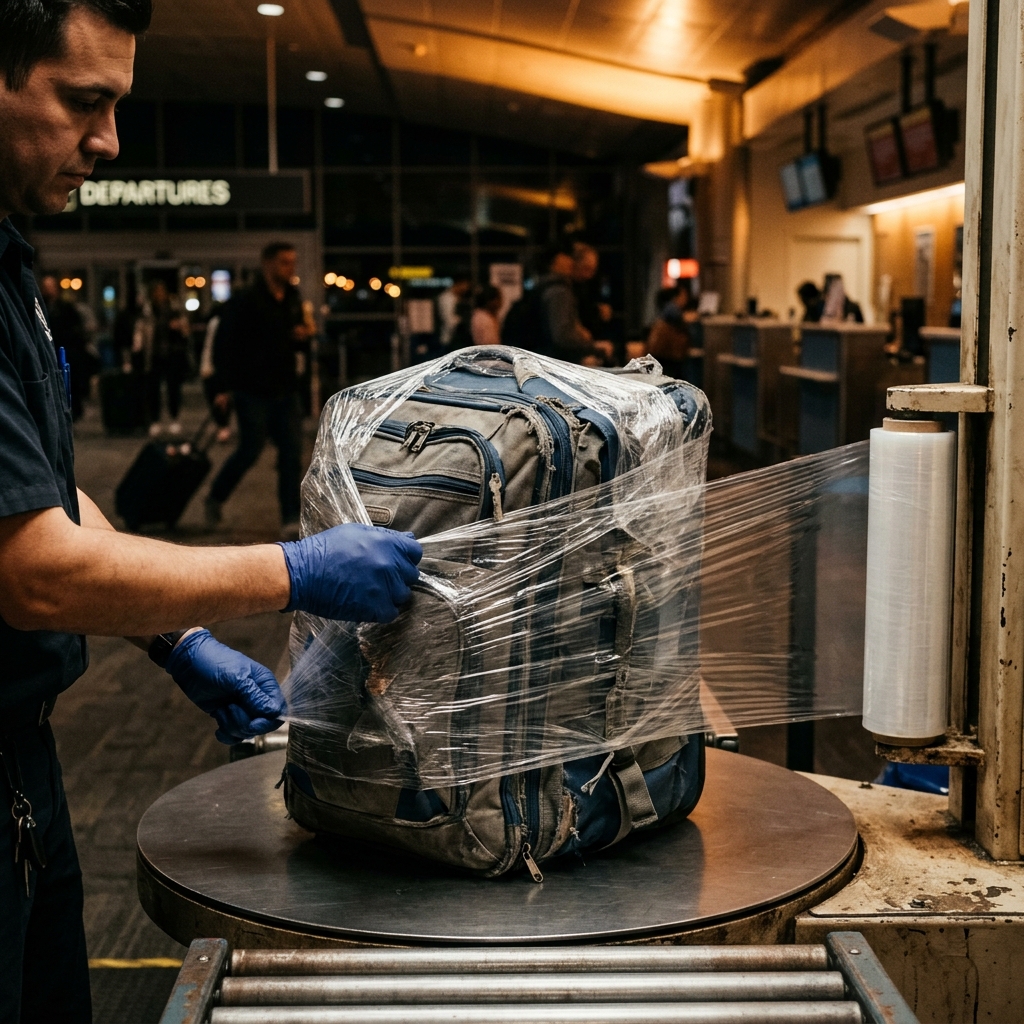
At many large international airports, there is a service near the check-in area that most travellers walk past without noticing: luggage wrapping. A machine and an operator. You place your bag on the turntable; any bag, in any condition. A battered holdall. A hard case with a broken clasp. A piece of sports equipment with a hand-written label that has been rubbed mostly off. Whatever you arrive with, they take it. Industrial plastic film goes around it. Handling labels get applied. A proper tag is attached. The bag leaves the counter travel-ready, regardless of the state it arrived in.
You do not need to arrive with the right bag. You need to arrive with your bag. The service meets you where you are.
And here is the part that matters: when you add a second piece of luggage to the same booking at that counter, the check-in agent immediately tells you what changes. Your first bag's checked allowance is affected. The routing tag on the fragile item needs to be updated. The weight distribution across the booking has shifted. Adding one thing to the system changes the system; and the system tells you what changed, rather than leaving you to discover it at baggage claim.
"The drawings were always the bottleneck. Not because the technology to produce them was unavailable. Because nobody had decided the tool should handle it."
What eety does with drawings
Actually, left me back up for a second. The drawings problem in patent practice is not one problem; it is four, and they are quite different from each other.
The first: the attorney has no drawings and needs them generated from scratch. eety translates the Brain's structured invention model directly into figure layouts: components, hierarchy, reference numerals, system architecture. No canvas. No separate tool. No illustrator. The figures are designed to complement the claims because they emerge from the same underlying understanding that generated the claims.
The second: the inventor has provided a rough sketch. Maybe a phone photograph of a whiteboard. Maybe a hand-drawn block diagram that is correct but not USPTO-compliant. eety can take that rough input and produce a compliant, properly formatted figure. The sketch is the starting piont; the output is the filed version.
The third: the attorney has their own drawings and wants to use them as-is. Fine. Upload them. They go in exactly as provided. The tool does not insist on redrawing what is already usable.
The fourth; and this is the one that most teams do not think about until it is too late: when you add or modify a figure, the reference numerals, the element names in the specification, the claim language that references specific components, and the cross-references between figures all need to be consistent. Change one figure; and the cascade runs through the document. eety surfaces that cascade. When a figure is added or modified, it shows the attorney which reference numerals appear in other figures that may need updating, which claim elements now have figure support that was previously missing, and which specification sections reference elements that have changed. The change notification is part of the feature.
Adding one thing to a connected system changes the system. The experience of using a good tool is knowing what changed; immediately, without hunting through twenty pages to find the inconsistency.
The partner I mentioned had never thought about drawings as a tool problem. He had always thought about them as a coordination problem: somebody has to make the drawings, somebody has to check them, somebody has to make sure the labels match the claims. What I found interesting, and I am genuinely not sure I have fully articulated this yet, is that the coordination overhead exists precisely because no tool has treated drawings as a first-class part of the drafting process. They are always an afterthought. A separate workstream. Something that happens outside the tool and gets inserted at the end.
The wrap station does not ask you to arrive with a travel-ready bag. It takes whatever you bring and makes it travel-ready. That is the standard the drawings experience should meet. :)
Experience It
Upload a sketch. Or left eety generate figures from the Brain. Either way.
Start Free →