1. "How long does a first draft take you?"
I ask this to every patent attorney I meet. The answers range from two days to a week, depending on complexity. Then I ask a follow-up: "And how much of that time is actually thinking, versus typing?"
There is usually a pause. Then something like… "Maybe 20%. The rest is just writing."
That 80% is where AI changes the economics of a patent practice. Not by replacing the thinking; that stays with the attorney, as it must. But by collapsing the time between a good idea and a well-drafted document from days to hours. The disclosure pipeline at any active firm keeps growing; the attorney hours available do not. Something has to give.
2. What AI actually does, and what it cannot
I have seen a lot of people either over-promise or over-fear AI for patent work. Both are unhelpful. So here is the honest version.
What AI does well
- Generating well-structured, grammatically fluent patent prose, at the speed of thinking, not typing
- Extracting and organising technical information from messy, incomplete invention disclosures
- Drafting consistent claim hierarchies once the independent claim strategy is set
- Producing first drafts of background, summary, and detailed description sections
- Generating initial patent drawing plans from the invention model
What AI cannot replace, no matter how good it gets
- Claim strategy: the attorney decides scope, breadth, and how aggressive to be
- Prior art judgment: only the attorney can decide what's "too close" to existing art
- Client counseling: filing decisions, continuation strategy, portfolio management are legal advice
- Prosecution: responding to an examiner's rejection requires legal reasoning, not text generation
AI is like a very fast, very capable junior associate who has read every patent ever granted; but they have never spoken to a client, never argued in front of an examiner, and cannot make a judgment call. Use it for the writing. Keep the judgment for yourself.
3. How to actually evaluate an AI drafting tool
I see a lot of firms make this decision based on a polished demo video and a convincing sales call. I understand why; time is short. But that approach will lead you to the wrong tool.
Here is what to test instead. Bring a real disclosure: not the one they give you; your own. Then run it through the tool.
Before you get to the checklist, it is worth understanding the foundational distinction that separates purpose-built patent AI from a general-purpose LLM; because the test questions are different depending on which category you are evaluating. I wrote about this in Why Prompting ChatGPT Is Not the Same as Using Patent-Drafting Software. The short version: patent drafting is not a text-generation problem. It is an invention-understanding problem. That distinction changes everything about how you should evaluate the tools.
Then check these five things:
| What to test | What the answer tells you |
|---|---|
| Does it ask you questions before drafting? | If no, it's a template machine. It doesn't understand your invention; it's filling a pattern. |
| What does independent claim 1 cover? | Does it protect what's actually novel, or what was mentioned first in the disclosure? |
| Ask it to explain the novelty | Can it do so in technical terms, unprompted? Or does it give you the disclosure paraphrased? |
| Check every claim limitation against the spec | Is there explicit written description support? Or are claims floating without a spec anchor? |
| Ask for their DPA documentation | Not a privacy policy link, but the actual enterprise Data Processing Agreement. Read it. |
4. The one distinction that matters most
I have spent a lot of time looking at AI patent tools; building one tends to make you obsessive about the competition :). And the single most important thing I look for is this: does the tool understand the invention, or does it just know what patents look like?
These are not the same thing. They produce radically different output.
A template-first tool has read millions of patents and can reproduce the style perfectly. Grammatically flawless; technically dense; reads exactly like a patent. But it models patent language, not patent thinking. It does not know what is novel about your client's invention. It just knows how to write about inventions.
An understanding-first tool builds a conceptual model of the invention before writing a word. It maps the inventive concept, identifies what is genuinely novel, surfaces the gaps in the disclosure, and grounds everything it writes in that model. The output looks similar on the surface; the quality difference shows up when an examiner pushes back.
"Give any AI patent tool your disclosure. Then ask: 'What is the single most novel aspect of this invention, and why doesn't it read on a prior art reference you can name?' The answer will tell you everything."
5. How to actually integrate AI into your workflow
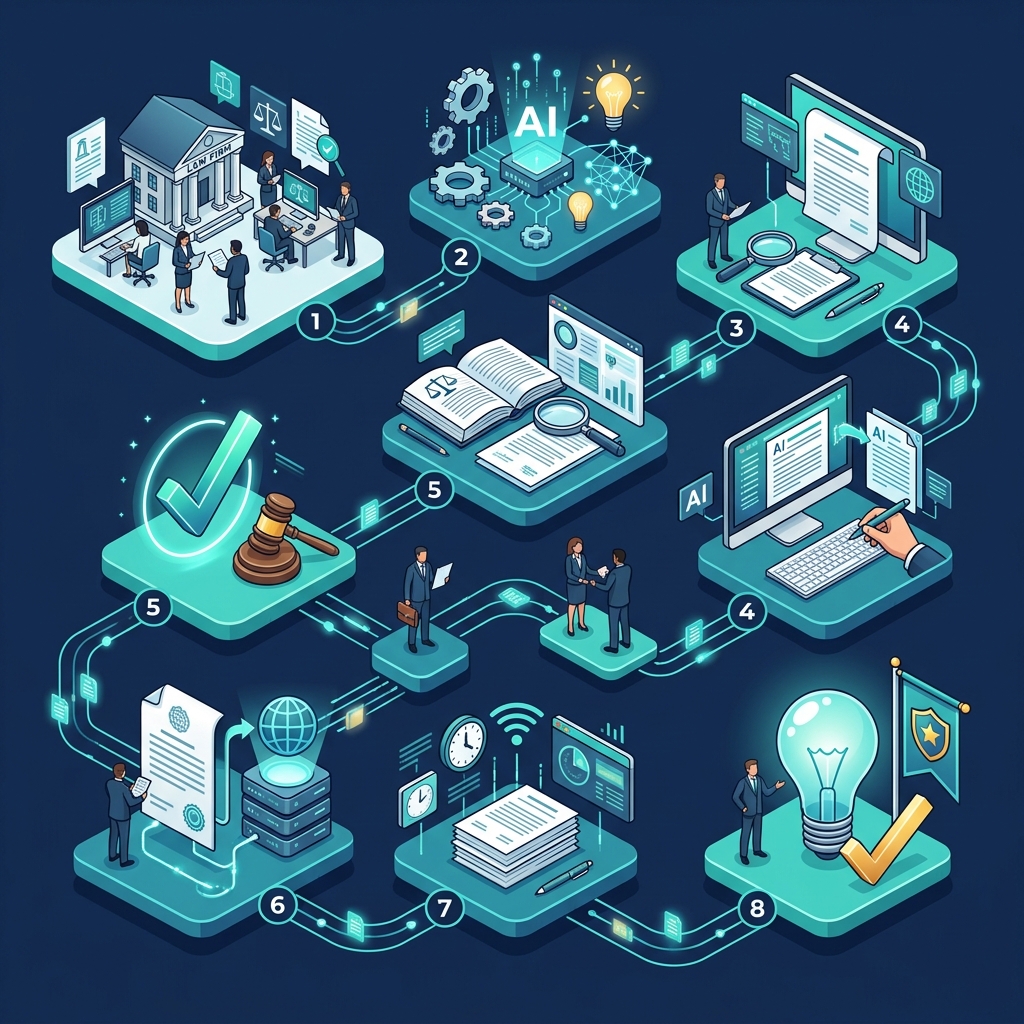
The firms that get the most out of AI patent tools are not the ones who just plug the tool into their existing process. They redesign the process around the tool. Here is what that looks like in practice.
Phase 1: Disclosure triage
Before you invest attorney time, use AI to extract a structured invention summary from the raw disclosure. In 30 seconds you know whether the disclosure is complete enough to begin drafting; what the probable novelty is; and what questions need to go back to the inventor.
Phase 2: Gap-filling interview
The AI identifies what is missing and generates targeted technical questions, not generic ones, but questions specific to the gaps in this disclosure. The attorney reviews them, sends the relevant ones to the inventor, and feeds the responses back. The draft gets better before it starts.
Phase 3: Draft plan approval
Before any prose is generated, the AI produces a paragraph-by-paragraph plan: what each section addresses, which figures it references, which claim elements it supports. The attorney reviews and approves this before execution. This is where claim strategy decisions happen; not mid-draft.
Phase 4: Section-by-section drafting
AI drafts one section at a time; the attorney reviews each before the next begins. Not a waterfall where you get a 30-page document to review at the end. A continuous loop where problems are caught early.
Phase 5: Drawings and export
AI generates initial patent drawing layouts from the invention model. The attorney reviews figures, adjusts reference numerals, and approves. Then exports the full application, ready for final review and filing.
6. What the attorney must still review, every single time
I want to be very clear about this. AI assistance does not reduce your responsibility as the attorney of record. What it does is change what you spend your review time on; from transcription to judgment.
Every application drafted with AI assistance needs explicit attorney review of:
- Independent claim scope: Is it as broad as it can be given the prior art you know about? Could it be broader?
- Written description support: Every word in every claim must have explicit support in the specification. No exceptions.
- Claim-figure consistency: Every claim element should appear in at least one figure with a reference numeral. Check this manually.
- Functional vs. structural language: Functional language is broader; it also invites means-plus-function treatment. Verify every instance was intentional.
- Inventorship: AI cannot determine who invented what. This must come from you and the disclosure.
The AI generates a first draft. You are the drafter of record. Your name goes on the filing. Your professional responsibility obligations are completely unchanged by what tools you used. Act accordingly.
7. The four security questions to ask before signing up for anything
I have noticed in many conversations with firm technology committees that the security evaluation of AI tools often stops at "they have a privacy policy." That is not sufficient scrutiny for client invention disclosures. Here is what to actually ask:
Those four questions are not rhetorical; I have answered each of them in depth for eety.ai in two dedicated articles. How eety.ai Protects Your Client's IP from Training Data Leaks covers the data handling architecture and what the DPA actually obligates. Why Security Is the DNA of eety.ai goes deeper into the two-phase model; why the disclosure is read once and then stays in encrypted storage for every subsequent drafting operation. Print both before the meeting with your managing partner.
- Do you have an enterprise Data Processing Agreement? Not a link to a privacy page, but a bilateral DPA that creates contractual obligations.
- Is our data used for model training, ever? "By default, no" is not the same as "never." Get a written commitment.
- Where is our data stored, and in which jurisdiction? This matters for attorney-client privilege and GDPR compliance if you have European clients.
- Who at your company can access our data, under what circumstances, and is that access logged? If they cannot answer this clearly; that is itself an answer.
ABA Formal Opinion 477 is clear that competence in technology is part of your professional responsibility. Understanding the security model of the tools your firm uses for client work is not optional; it is an obligation.
8. How to make the case to the rest of your firm
"I tried to convince my managing partner once," a patent attorney told me. "I showed him a demo. He asked one question: 'What happens to client confidentiality?' I didn't have a good answer. The conversation ended there."
She came back a month later, with the DPA documentation, the encryption specs, and the firm-isolation architecture explained in plain English. The conversation was different.
Three things that tend to work when making this case internally:
Frame it as time recovery, not headcount reduction
If your firm hears "AI replaces associates," the conversation is over before it starts. The frame that works better: "This gives our attorneys 10–15 more hours per application to spend on prosecution strategy, client counseling, and business development." That is additive, not threatening.
Run a pilot on three real applications, not a demo
One attorney, three applications, 60 days. Track time-to-first-draft, time-to-filing, and honestly, attorney satisfaction with the output. The data will make the case more convincingly than any presentation I could put together for you.
Answer the security question before it is asked
Walk into the meeting with the DPA documentation already printed. Partners who sit on IP practice committees will ask; you want to be the person who hands them the document before they finish the question.
At the end of all of this… you may launch it, take it to your firm, run the pilot, and it might still fail. I have launched things that have failed :). But the alternative is watching your competitors figure this out while you're still waiting for the perfect moment to start.
Start Your Pilot
Full access. No credit card. See the difference in your first application.
Used by patent attorneys at firms across North America, Europe, and India.
Try eety.ai Free →