Legal practice operates on accountability. An attorney who signs a patent application is personally responsible for its content. Not the tool. Not the AI. The attorney. If a claim introduces a limitation that was not in the disclosure, the attorney cannot say the AI did it and expect that to be a satisfactory response. They are suppose to have reviewed it. Supervised it. Stood behind it.
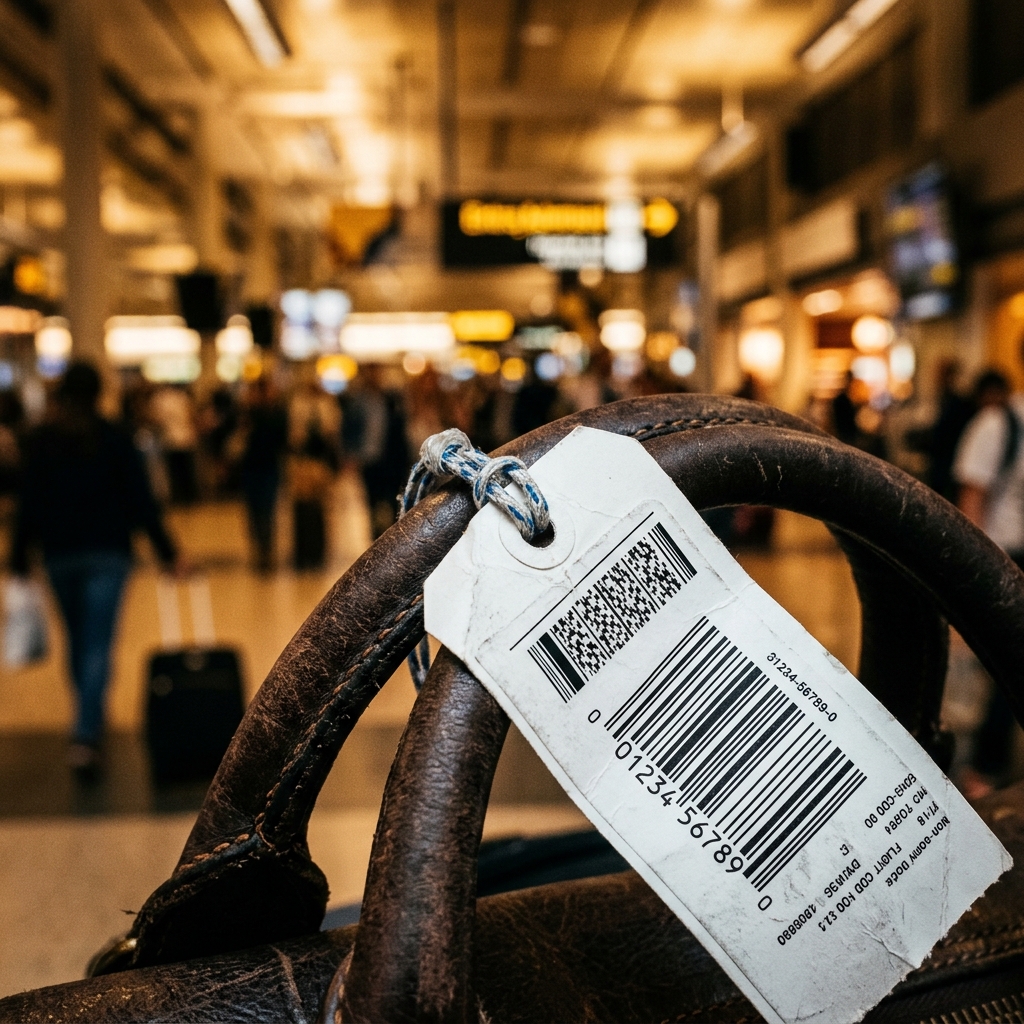
And yet most AI tools make this accountability genuinely difficult to exercise. The text appears. The attorney reads it. But the question, where did this come from; which part of the disclosure drove this specific limitation; was this explicitly described or was this inferred, has no answer that the tool can give. There is no tag. The bag moved through the system and arrived at its destination, and nobody can tell you how it got there.
What the baggage tag actually does
When you check a bag at an airport, a tag gets attached. A barcode, linked to your booking reference, your name, your flight, your destination, and usually your onward connection if there is one. That tag is what allows a ground crew member in Frankfurt to know that the black holdall on conveyor belt 7 belongs on the flight to Edinburgh, not the one to Dubai. The tag is not decoration. The tag is the infrastructure that makes the whole system trustworthy.
Without the tag, the bag is just a bag. It moved through the system. It arrived somewhere. But the link between where it came from and where it was supposed to go exists only if you can read the tag. A bag without a tag is not a bag that moved correctly; it is a bag that moved anonymously, and anonymity in a system with this many junctions is how things get lost.
"You cannot stand behind a claim you cannot trace. And you cannot trace a claim that moved through the system without a tag."
What traceability looks lke in eety
As each stage of a drafting chain completes, eety writes a structured narrative into the chat: which Brain fields were consulted, which novelty dimension was prioritised, which elements of the disclosure were drawn upon, and what reasoning was followed in making key structural choices. When it drafts Claim 1, it summarises the specific invention understanding that drove the claim scope. When it transitions from claims to specification, it notes which dependencies it maintained and why.
This is not a debugging log for engineers. It is a professional record for the attorney. You can read the cascade narrative alongside the draft and understand what deductive leaps the model made. You know when to agree with those leaps and when to redirect. You can trace any claim element back to the source material that grounded it; before the filing leaves your desk.
Senior attorneys who have used this tell me that the cascade narrative is often as valuable as the draft itself. Not because the reasoning is always correct; sometimes it surfaces an assumption worth challenging. But because having the reasoning at all changes the nature of the review. Instead of re-deriving the intent of every sentence from the output text alone, the attorney can read the tag. They know where the bag came from. They know whether it belongs here.
A claim without a traceable source is a bag that moved through the system anonymously. That sentence sounds more alarming than it did when I first wrote it... which I think means it is correct. :)